

Disclosure: “The owners of this website may be paid to recommend Goldco or other companies. The content on this website, including any positive reviews of Goldco and other reviews, may not be neutral or independent.” Learn More
This Kinesis Money review answers the question conservative savers keep asking: can you actually own audited, spendable gold through a digital platform without getting burned?
I dug into the fee stack, the audit reports, the tax traps, and 695 Trustpilot complaints because the affiliate sites quoting a shiny 4.x-star rating left out the parts that cost real money.
What follows is the honest math, the regulatory fine print, and who this platform genuinely fits.
Table of Contents
- 1 Quick Verdict: Is Kinesis Money Worth It?
- 2 What Is Kinesis Money?
- 3 Kinesis Money Fees: The Complete Breakdown
- 4 Kinesis Yields: What You’ll Actually Earn
- 5 Is Kinesis Money Legit and Safe?
- 6 Taxes: The Cost Nobody Warns You About
- 7 Kinesis Money vs. Alternatives
- 8 How to Open a Kinesis Account (and What to Expect)
- 9 Who Should (and Shouldn’t) Use Kinesis Money
- 10 Frequently Asked Questions
- 10.1 Q1. Is Kinesis Money Legit?
- 10.2 Q2. Is Kinesis Money Regulated?
- 10.3 Q3. What Is the Difference Between KAU and KAG?
- 10.4 Q4. How Much Yield Does Kinesis Money Pay?
- 10.5 Q5. Can I Take Physical Delivery of My Gold From Kinesis?
- 10.6 Q6. What Are Kinesis Money’s Withdrawal Fees and How Long Do Withdrawals Take?
- 10.7 Q7. What Happens to My Gold if Kinesis Goes Bankrupt?
- 10.8 Q8. Is Kinesis Money Better Than PAX Gold?
- 10.9 Q9. Do I Pay Tax When I Spend Gold With the Kinesis Card?
- 10.10 Q10. Does Kinesis Money Offer a Gold IRA?
- 11 Final Verdict
Quick Verdict: Is Kinesis Money Worth It?
Kinesis is a legitimate, audited precious-metals platform with a real innovation: gold you can spend, backed 1:1 and stored at 0% cost. The catch sits in funding friction, weak consumer protection, and tax surprises most reviews skip.
| Category | Score /5 | One-Line Reason |
| Fees | 4/5 | Flat 0.22% trade fee is low, but funding and withdrawal costs add up |
| Backing / Audits | 4.5/5 | 1:1 allocated metal, biannual Bureau Veritas audits, blockchain-verifiable |
| Yields | 3/5 | Real metal payouts, but the “57.5% of fees” framing oversells returns |
| Withdrawals | 2.5/5 | $25 flat fee, $100 minimum, and documented multi-day to multi-week delays |
| Support | 3.5/5 | 24/7 live chat and account coaches praised, yet account locks frustrate some |
| Regulation | 2.5/5 | CIMA VASP registration exists but offers no compensation scheme |
- Best for: Sound-money savers who want allocated, audited gold they can hold, spend, and redeem physically.
- Not for: US ACH funders, active day-traders, anyone needing FDIC/SEC-grade protection, or savers wanting a Gold IRA.
The scorecard tells you Kinesis earns its legitimacy on the metal side and loses points on the money-movement and protection side. Keep that split in mind as you read.
What Is Kinesis Money?

Kinesis launched in 2018 under founder and CEO Thomas Coughlin, built on the bones of the Allocated Bullion Exchange (ABX), a physical bullion exchange operating since 2011.
That lineage matters because ABX brings a real global vault network across Zurich, London, New York, Singapore, Sydney, and Dubai. The stated mission is simple: turn gold and silver back into money you can actually use.
Today Kinesis says it serves users in 151 countries and runs on a fork of the Stellar blockchain. The ecosystem breaks into four spendable parts:
- Kinesis Exchange: a trading venue for metals, stablecoins, and crypto.
- Kinesis Mint: custom bullion minting from your digital holdings.
- Kinesis Pay: merchant payments made in gold or digital assets.
- Kinesis Card: a Mastercard-linked spending card (still in beta) with cashback paid in gold.
Each piece feeds one idea: metal that moves like currency instead of sitting locked in a vault.
KAU, KAG, KVT and C1USD Explained
Here is the token lineup in plain terms:
- KAU is one gram of physical gold, held 1:1 in allocated storage.
- KAG is one troy ounce of physical silver, held 1:1 in allocated storage.
- KVT is the Kinesis Velocity Token, an equity-like token that pays a share of platform fees. It is not metal-backed, a distinction some reviews blur.
- C1USD is Currency One USD, a stablecoin pegged 1:1 to the dollar that advertised a 7.5% APY (it replaced the earlier USD1 in September 2025).
If you buy KAU or KAG, you own metal. If you buy KVT, you own a speculative fee-share instrument. Treat those two categories as completely different risk buckets.
How the 1:1 Backing and Audits Work
Your KAU and KAG represent allocated bullion, meaning specific metal is legally yours and never lent out, versus unallocated metal where you hold a claim against a pool. That legal distinction is the backbone of the platform’s safety pitch.
Kinesis undergoes independent audits twice a year through Inspectorate International, part of Bureau Veritas. Audit reports are published, and every token is traceable on the Kinesis blockchain explorer.
You can cross-check the metal count against the token supply yourself, which is more transparency than most bullion dealers offer.
Kinesis Money Fees: The Complete Breakdown
The trade fee is genuinely low. The trouble is that buying gold is only one line in a longer receipt. Here is the full picture, drawn from the Kinesis fees page (accessed for this review):
| Fee Type | Cost |
| Trade (buy/sell) | 0.22% |
| Send fee | 0.45% |
| Storage | 0% |
| US deposit (ACH via Banxa) | 1.99% ($20 min, $20,000 max) |
| Card deposit (third-party) | ~2.59%–3.49% ($2 min) |
| Fiat withdrawal | $25 / €25 / £25 ($100 minimum) |
| Physical redemption | 0.45% + $100 + delivery, min 100g gold / 200oz silver |
Storage costs you nothing because transaction-fee revenue funds the insured vaults. That is a real advantage over rivals charging monthly storage. The funding and withdrawal fees, though, are where careful savers get surprised.
The Real Cost of a Round Trip
Nobody totals the full journey from deposit to withdrawal, so let’s do it. Say a US investor puts in $10,000, buys KAU, holds 12 months, sells, and withdraws to a bank.
| Step | ACH Path | Wire Path |
| Deposit | 1.99% = $199 | ~$25 flat wire cost |
| Buy KAU | 0.22% = ~$21.60 | 0.22% = ~$21.95 |
| Storage (12 mo) | $0 | $0 |
| Sell KAU | 0.22% = ~$21.60 | 0.22% = ~$21.95 |
| Fiat withdrawal | $25 | $25 |
| Total cost | ~$267 (2.67%) | ~$94 (0.94%) |
The lesson jumps off the page: funding by ACH nearly triples your round-trip cost versus a bank wire. A UK or EU user avoids the 1.99% ACH sting entirely by using SEPA or a bank transfer, landing closer to the 0.94% wire figure plus the £25/€25 withdrawal. Fund by wire or regional bank transfer, never by card or ACH, and your metal purchase stays cheap.
Kinesis Yields: What You’ll Actually Earn

Here is the honest version of the yield story. Kinesis redistributes 57.5% of every fee collected on the platform back to users each month, paid in gold and silver.
That is a share of platform revenue, not an interest rate on your holdings. Your payout depends on total platform activity, not on a fixed APY.
The six yields work like this:
- Holder’s Yield: rewards you for simply holding KAU/KAG.
- Velocity Yield: rewards spending and transacting.
- Referrer’s Yield: pays you for users you refer.
- Minter’s Yield: rewards minting new tokens through deposits.
- KVT Yield: pays KVT holders a fee share.
- Partner’s Yield: rewards approved commercial partners.
Read the mechanic carefully: a quiet platform means smaller payouts, no matter how much gold you hold.
Historical Holder’s Yield Payouts
The Kinesis yield statistics page publishes monthly payout data. Once you convert those monthly Holder’s Yield figures into an annualized rate on holdings, the effective return on a pure hold position has historically landed in the low fractions of a percent, well under 1% annually in many months, not the double-digit number the “57.5% of fees” phrasing implies.
The marketing frames a revenue-share slice as if it were a savings rate. Track the actual monthly payouts against your own balance before you count on yield as income. The gold you earn is real; the amount is modest.
The KVT Problem
KVT is the part of the ecosystem I’d flag hardest for cautious savers. Its price has swung sharply, and Trustpilot carries user reports of meaningful losses on KVT positions. Minting-promo terms have also shifted over time, catching buyers who expected the original conditions.
Treat KVT as a speculative equity-style bet on platform growth, fully separate from your metal. If you want safety, stay in KAU and KAG.
Is Kinesis Money Legit and Safe?
Yes, Kinesis Money is legitimate, with real caveats around regulation and untested bankruptcy scenarios. The evidence supporting legitimacy is concrete:
- Biannual independent audits by Bureau Veritas with published reports.
- Legal title to allocated metal that stays off the company’s balance sheet.
- Fully insured vaults across an established ABX network.
- A blockchain ledger anyone can verify.
That combination puts Kinesis well above the fly-by-night operators. The weaknesses are about protection, not authenticity.
Regulation: What CIMA VASP Registration Actually Covers
Search results contradict each other, so let’s settle it. WikiFX labels Kinesis “unregulated.” Kinesis is in fact registered as a Virtual Asset Service Provider with the Cayman Islands Monetary Authority (CIMA), reference number 1877923.
VASP registration means the company is recognized and monitored for anti-money-laundering compliance. What it does not mean is bank-grade oversight.
There is no deposit insurance, no compensation scheme, and no equivalent of FCA or SEC investor protection. If something goes wrong, no government fund makes you whole. That is a materially weaker safety net than a US-regulated custodian.
What Happens to Your Gold If Kinesis Fails?
Your metal is legally yours and held via the ABX vault network, separate from Kinesis’s corporate balance sheet. In theory, if Kinesis went insolvent, the bullion isn’t part of the bankruptcy estate to be handed to creditors.
The honest caveat: this structure has not been tested in an actual bankruptcy court. Legal ownership on paper and clean recovery in a real insolvency are two different things. Assume some friction and delay in a worst-case scenario, even with good documentation.
What 695 Trustpilot Reviews Actually Say
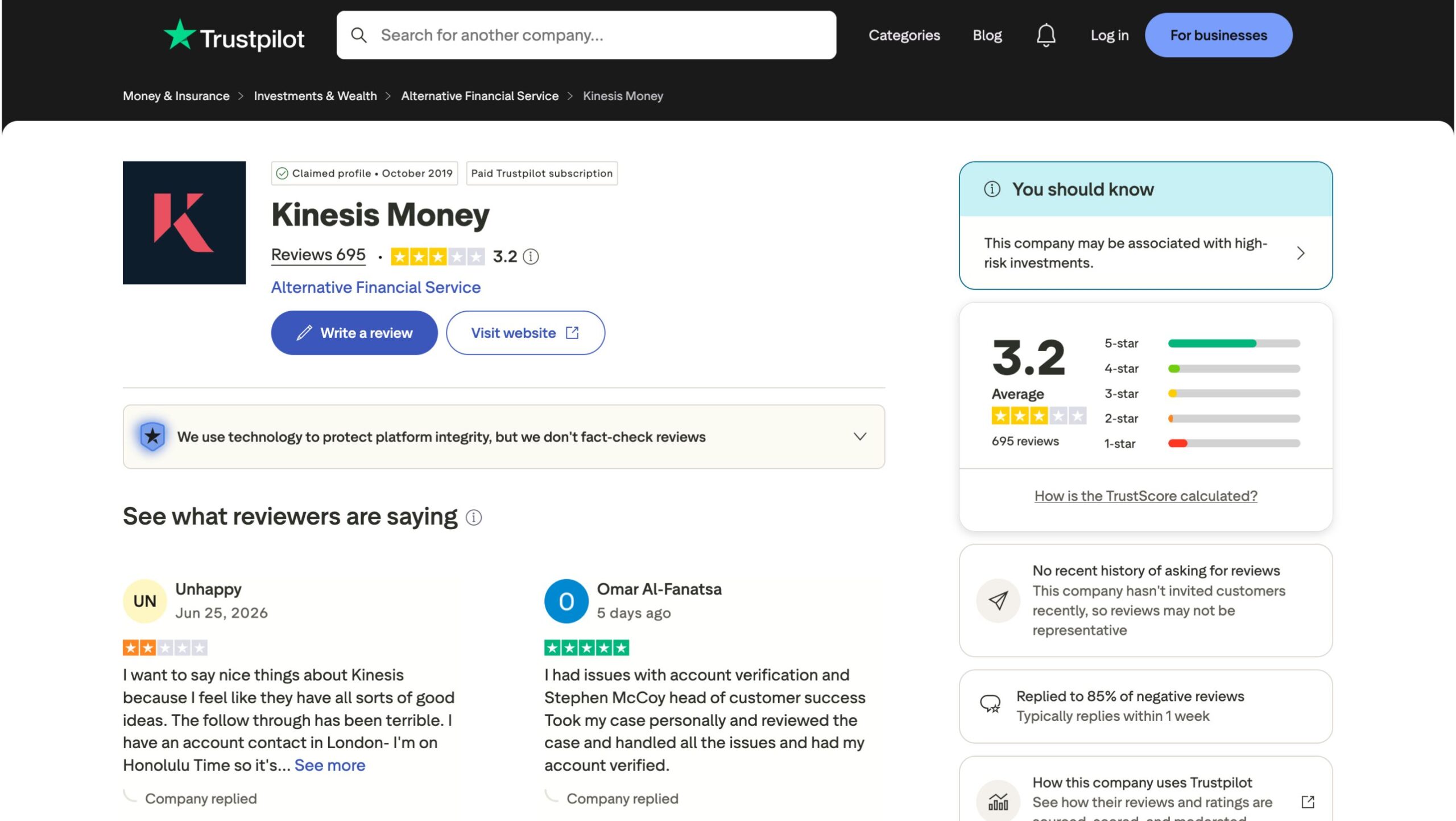
Affiliate sites love quoting the old 4.x-star era. The current Trustpilot rating sits at roughly 3.2/5 across nearly 700 reviews, and the drop tells a story. Here are the recurring complaint patterns, paraphrased:
- Withdrawal delays: a common theme, ranging from several days to several weeks, including one alleged $69,000 payment held over a year under “compliance review.”
- KYC/onboarding failures: white-screen verification errors requiring multiple support escalations.
- Account locks: compliance holds that blocked users from redeeming their own metal.
- Funding friction and fees: frustration at the $25 charge every time money returns to a bank.
Balanced against those, genuine praise clusters around the concept itself, tight buy/sell spreads, earning gold through everyday Metalback spending, and responsive personal account coaches (one reviewer’s rep returned a missed call in under 30 seconds). The pattern is clear: people love the product and get burned by the plumbing.
Taxes: The Cost Nobody Warns You About
No top-ranking review touches this, and it can cost you more than any platform fee.
In the US, the IRS treats physical gold and silver as collectibles, meaning long-term capital gains can be taxed at rates up to 28%, higher than the 15%–20% on stocks. Worse, every time you spend gold on the Kinesis Card or swap metal-to-metal, that counts as a taxable disposal. Yields paid in metal are likely ordinary income at receipt.
In the UK, disposals trigger Capital Gains Tax through HMRC. The CGT exemption that applies to UK sovereign coins like the Britannia does not extend to KAU, since it isn’t legal-tender coinage.
Every card tap is potentially a reportable event. Consult a qualified tax professional before treating Kinesis gold as everyday spending money.
Is Kinesis Money Halal?
The gold backing appeals to Islamic finance users because it represents real, allocated metal rather than debt. The yield system’s permissibility, though, is actively debated on Islamic finance forums like IFG, since fee-sharing structures raise questions under Shariah rules.
If Shariah compliance matters to you, check the platform’s current scholarly certification status directly before committing. Treat it as unresolved rather than confirmed.
Kinesis Money vs. Alternatives
| Feature | Kinesis | PAX Gold | Glint | OneGold | Goldmoney |
| Backing | 1:1 allocated | 1:1 allocated | Allocated | Allocated | Allocated |
| Trade fee | 0.22% | ~0.02% network | ~0.5% FX | ~0.1–0.5% | ~0.5% |
| Storage | 0% | 0% | 0.02%/mo | ~0.4%/yr | ~0.5%/yr |
| Yield | Yes (metal) | No | No | No | No |
| Card | Yes (beta) | No | Yes | No | No |
| Redemption min | 100g gold | 430g bar | Coins/bars | Varies | Varies |
| Regulation | CIMA VASP | NYDFS | FCA-adjacent | US | Regulated |
PAX Gold wins on regulation but offers no yield or card. Glint is card-first but charges storage. OneGold and Goldmoney are solid custodial holders without the spend-and-earn features. Kinesis stands out for combining audited metal, 0% storage, yield, and a spending card in one place.
Kinesis vs. PAX Gold (PAXG)
PAXG is denominated per troy ounce; Kinesis KAU is per gram, so smaller entry sizes work more naturally on Kinesis. PAXG pays no yield and requires a 430g bar minimum for physical redemption versus Kinesis’s 100g.
The big divergence is regulation: Paxos is supervised by the NYDFS, a genuine US regulator, while Kinesis relies on CIMA registration. For US savers who prize oversight, PAXG holds the edge.
Kinesis vs. Glint
Glint is built around its card first, ecosystem second. It charges roughly 0.02% per month for storage, while Kinesis charges nothing. Glint operates in FCA-adjacent UK territory, giving it a friendlier consumer-protection posture than Cayman registration.
Kinesis counters with yields and a wider set of tools. If storage cost and UK regulation matter most, Glint appeals; if earning metal matters, Kinesis leads.
How to Open a Kinesis Account (and What to Expect)
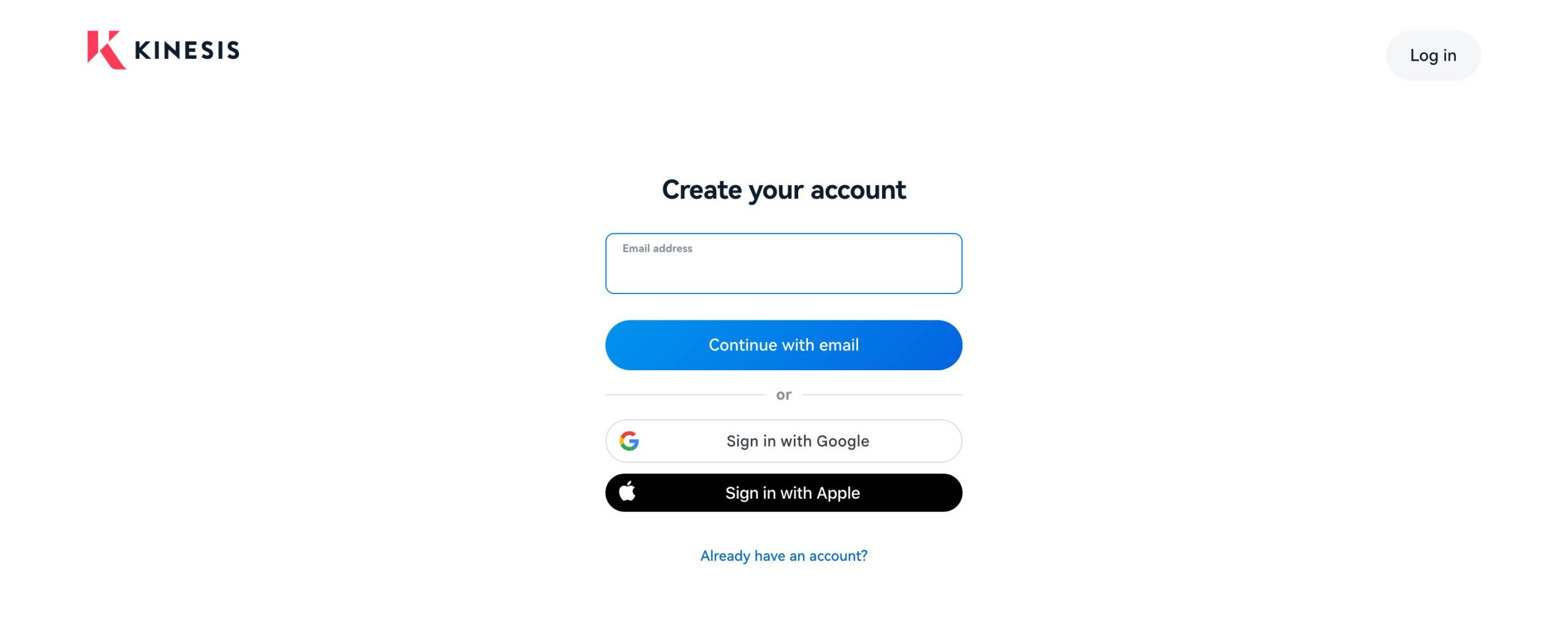
The signup is free and fast in theory, slower in practice thanks to identity checks. Here is the realistic five-step path:
- Register with email or Google (a few minutes).
- Complete KYC via the Persona verification vendor. Expect proof-of-address rejections and occasional white-screen errors, so have a clear utility bill or bank statement ready.
- Fund the account by bank wire in one of 12 currencies (cheapest) or card/ACH (pricier). Deposits can take anywhere from minutes to a few days.
- Buy KAU or KAG with one click, or set a limit-style “Set Your Own Price” order.
- Confirm holdings and optionally verify them on the blockchain explorer.
The friction almost always hits at step two. Submit a crisp, recent proof-of-address document the first time to avoid the escalation loop other users describe.
Who Should (and Shouldn’t) Use Kinesis Money
Some savers will love this platform, and others should walk away. Match yourself honestly.
Good fit:
- Sound-money savers who want spendable, audited, allocated metal.
- Users outside the US funding by wire or SEPA.
- People who value 0% storage and blockchain-verifiable holdings.
Poor fit:
- US investors funding by ACH (the 1.99% fee erodes returns).
- Active traders needing deep liquidity and low spreads.
- Anyone requiring regulated custody, deposit insurance, or a compensation scheme.
- Retirement savers wanting a Precious Metals IRA, since Kinesis offers none.
If your goal is IRA-eligible gold inside a US retirement account, Kinesis simply isn’t the tool. A US bullion dealer with custodian relationships fits that need instead.
Frequently Asked Questions
Q1. Is Kinesis Money Legit?
Yes, Kinesis Money is legitimate. It holds 1:1 allocated metal audited twice yearly by Bureau Veritas, publishes verifiable blockchain records, and is registered as a CIMA VASP in the Cayman Islands. The caveats are weak regulatory protection and documented withdrawal delays, not fraud.
Q2. Is Kinesis Money Regulated?
Kinesis is registered as a Virtual Asset Service Provider with the Cayman Islands Monetary Authority (reference 1877923).
This covers anti-money-laundering compliance but provides no deposit insurance or investor compensation scheme, making it weaker than FCA or SEC oversight.
Q3. What Is the Difference Between KAU and KAG?
KAU represents one gram of allocated physical gold, while KAG represents one troy ounce of allocated physical silver.
Both are backed 1:1 by metal stored in insured vaults and are fully redeemable, spendable, and tradeable on the platform.
Q4. How Much Yield Does Kinesis Money Pay?
Kinesis redistributes 57.5% of platform fee revenue monthly, paid in gold and silver. This is a revenue share, not a fixed APY. Effective Holder’s Yield on a pure hold position has historically been modest, often well under 1% annually.
Q5. Can I Take Physical Delivery of My Gold From Kinesis?
Yes. Physical redemption is available through Brinks and Loomis Zurich, with minimums of 100g of gold or 200oz of silver. The cost is 0.45% plus a $100 fee plus delivery charges that vary by country.
Q6. What Are Kinesis Money’s Withdrawal Fees and How Long Do Withdrawals Take?
Fiat withdrawals cost a flat $25/€25/£25 with a $100 minimum. Processing usually takes a few days, though Trustpilot reviews report delays ranging from several days to several weeks, especially when compliance reviews are triggered.
Q7. What Happens to My Gold if Kinesis Goes Bankrupt?
Your metal is legally yours and held off Kinesis’s balance sheet through the ABX vault network, so it should not become part of a bankruptcy estate. This structure remains untested in an actual insolvency, so expect potential delays.
Q8. Is Kinesis Money Better Than PAX Gold?
It depends on your priorities. Kinesis offers yields, a spending card, and gram-sized units. PAX Gold offers stronger US regulation through Paxos and the NYDFS. For yield and spendability, Kinesis wins; for regulatory protection, PAXG wins.
Q9. Do I Pay Tax When I Spend Gold With the Kinesis Card?
Yes, in most cases. In the US and UK, spending gold or swapping metals counts as a taxable disposal, potentially triggering capital gains tax. US collectibles rates reach up to 28%. Consult a tax professional before treating gold as spending money.
Q10. Does Kinesis Money Offer a Gold IRA?
No. Kinesis Money does not offer a Precious Metals IRA. It is a Cayman-registered digital platform, not a US IRA custodian. Retirement savers wanting IRA-eligible gold should use a US bullion dealer with custodian relationships instead.
Final Verdict
Kinesis Money earns a solid but qualified rating. Its single biggest strength is audited, allocated metal stored at 0% cost with blockchain verification, a genuinely rare combination.
Its biggest weakness is the pairing of funding and withdrawal friction with thin regulatory protection and no compensation scheme.
Extractable summary: Kinesis Money is a legitimate platform for owning spendable, audited gold, best suited to non-US savers funding by wire. Avoid it if you need regulated custody, low-cost US funding, or a Gold IRA.
Goldco Precious Metals
- Goldco Surpasses $2 Billion in Precious Metals Placements
- Over 6,000 Five-Star Ratings on BBB, Trustpilot, and ConsumerAffairs
- Seven-Time Winer on the Inc. 5000 List