
Disclosure: “The owners of this website may be paid to recommend Goldco or other companies. The content on this website, including any positive reviews of Goldco and other reviews, may not be neutral or independent.” Learn More
No, Edward Jones does not let you hold physical gold, silver, platinum, or palladium inside a self-directed IRA. If your goal is owning real bullion stored in an approved vault, Edward Jones is not the place to do it.
I spent time reading the firm’s own disclosures, its fee pages, and what people say about it on independent rating sites, so you don’t have to.
In this review, you’ll get the honest verdict, a clear look at what Edward Jones actually offers, what it costs in real dollars, how customers rate it, and where to go if physical metals are what you really want.
The Short Answer on Edward Jones and Physical Gold
Edward Jones is a full-service brokerage and wealth-management firm. It is not a precious-metals dealer, and it is not a self-directed IRA custodian.
That distinction matters more than it sounds. A Gold IRA, sometimes called a precious-metals IRA, is a special type of self-directed account allowed under the Internal Revenue Code.
It lets you hold IRS-approved bullion stored at an approved depository like Delaware Depository or Brink’s Global Services. Edward Jones has no relationship with those depositories and no self-directed structure to support physical metal.
Here is the line that trips people up:
- Owning physical gold means you hold actual coins or bars, vaulted and insured, that you could eventually take delivery of.
- Gold exposure on paper means you own a fund or stock whose value tracks the price of gold, but you never own metal.
Edward Jones can give you the second kind. It cannot give you the first. One ranking page I found online flatly claims Edward Jones offers a self-directed gold IRA. That is wrong, and if you read it elsewhere, ignore it.
A Closer Look at the Firm Behind the Name
Before judging a company on one product it doesn’t carry, it’s fair to look at what it actually is. Edward Jones has a long history and a footprint bigger than almost any rival, which is part of why so many retirees already hold accounts there.
Roots, Ownership, and Who Runs It Today
Edward D. Jones Sr. founded the firm in 1922 in St. Louis. More than a century later, the home office still sits in the St. Louis area, at Des Peres, Missouri.
What sets Edward Jones apart structurally is its ownership. The firm is privately held and operates as a partnership owned by its own associates, under the parent company The Jones Financial Companies, L.L.L.P. (JFC), which files reports with the SEC. There is no publicly traded stock.
Penny Pennington has served as managing partner, the firm’s CEO role, since 2019. She is frequently cited as the only woman running a major U.S. brokerage and was named to Fortune’s Most Powerful Women in Business list in 2024. That partnership model and long tenure give the firm a stability you don’t always find in finance.
Scale, Branch Network, and Who They Serve
Edward Jones built its business on one idea: a single advisor in a small neighborhood office, close to where you live. That model produced a staggering footprint.
- Roughly 15,000 branch offices across the U.S. and Canada
- Around 9 million individual investors served
- About $2.5 trillion in client assets under care as of late 2025
- Roughly 55,000 associates
After the bullet points, the takeaway is simple: this is one of the largest brokerages in the country by office count, and the local-advisor relationship is its entire selling point. You walk into a branch, you sit across from one person, and that person stays with you for years.
What You Can Actually Invest In Through Edward Jones

If physical metal is off the table, it’s worth knowing what is on the table, because the lineup is broad and covers most of what a typical retirement saver needs.
Everyday Investments and Account Choices

Edward Jones offers a standard, full menu of traditional securities:
- Stocks and bonds
- Mutual funds and ETFs
- Certificates of deposit (CDs)
- Annuities
- Unit investment trusts (UITs)
You access these through a few account types. The Select Account is a transactional brokerage where you pay a commission per trade and there’s no account minimum.
Guided Solutions is a wrap-fee program where you stay client-directed but pay a flat asset-based fee. Advisory Solutions is the discretionary version, where the firm manages the portfolio for you.
The right choice depends on how hands-on you want to be and how much you’re comfortable paying for help.
Retirement and Goal-Based Accounts

For retirement and life-stage planning, Edward Jones covers the usual ground:
- Traditional IRA, Roth IRA, SEP IRA, and SIMPLE IRA
- 401(k) rollovers and Roth conversions
- 529 education savings plans, custodial accounts, and Coverdell ESAs
- Trust and estate services through Edward Jones Trust Company
- Life, disability, and long-term care insurance
After that list, here’s the honest read: rollovers are a core service here. A standard 401(k)-to-IRA rollover is routine. What you cannot do is roll any of it into physical bullion, because the account structure to hold metal simply isn’t there.
The Gold-Related Options That Do Exist Here
You’re not entirely shut out of gold at Edward Jones. You just have to accept a different form of it, and you need to understand exactly what you’re buying.
Gold Exposure Without the Bullion
Edward Jones can put gold-linked products in your existing IRA or brokerage account. These include:
- Gold exchange-traded funds (ETFs) such as SPDR Gold Trust (GLD) or iShares Gold Trust (IAU)
- Precious-metals mutual funds
- Shares of gold mining companies
This is what the industry calls “paper gold.” After the list, the critical point: you are buying exposure to the price of gold, not gold itself. You can’t store it. You can’t take delivery of a coin.
If a fund holds bullion on your behalf, you still own a share, not the metal. For some investors that’s perfectly fine. For others who specifically want a tangible store of value outside the financial system, it misses the point entirely.
Why the Self-Directed Structure Is Missing
The reason physical metal isn’t possible at Edward Jones is structural, not a temporary gap. A Gold IRA requires a self-directed IRA custodian, firms like Equity Trust or Strata Trust, working with an IRS-approved depository and an insurer.
Edward Jones is built around managed and advised accounts holding conventional securities. It has no IRS-approved depository relationship and no self-directed framework for alternative assets.
That’s by design. The firm chose to be a relationship-driven advisory shop, not an alternative-asset custodian.
Breaking Down What Edward Jones Charges

Cost is where many readers in their 50s and 60s get most cautious, and rightly so. Edward Jones tends to describe its pricing as “it depends on the account” rather than publishing a clean rate card. Here’s what the disclosures and third-party summaries reveal.
Advisory and Account Fees

In the Advisory Solutions program, the firm charges an asset-based program fee that starts around 1.35% annually and tiers down as your balance grows. On top of that sits a portfolio strategy fee of about 0.09% when the firm builds and manages the strategy.
On a $300,000 portfolio, a 1.35% program fee works out to roughly $4,050 per year. That buys you a managed account and a human advisor. Whether that’s worth it depends entirely on how much guidance you actually use.
Commissions, Sales Charges, and the Fine Print
In a transactional Select Account, the math looks different. Based on summaries from ConsumerAffairs, you may pay:
- Commissions up to roughly 2.5% of principal, with a minimum near $50 per trade
- A transaction fee around $4.95 on many trades
- Mutual fund, 529, and annuity sales charges ranging from 2.25% to 5.75%
- A transfer or account-closing fee around $95 per account
After the list, here’s a real example: invest $20,000 in a mutual fund carrying a 5.75% front load, and you hand over $1,150 before your money even goes to work. Those upfront sales charges are common in full-service brokerages but rare at low-cost discount brokers.
One more thing worth knowing: Edward Jones is a dually registered broker-dealer and investment adviser, not a pure fiduciary across every account, a point critics raise often.
How Edward Jones Stacks Up on Independent Rating Sites
Reputation tells you what the marketing won’t. I pulled the numbers from the major rating platforms, so you can see the pattern, not just one cherry-picked score.
| Source | Score | Notes |
| Better Business Bureau (St. Louis) | A- rating, not accredited | Two government-action alerts; complaints about fund access and reaching reps; dinged for failing to respond to 2 complaints |
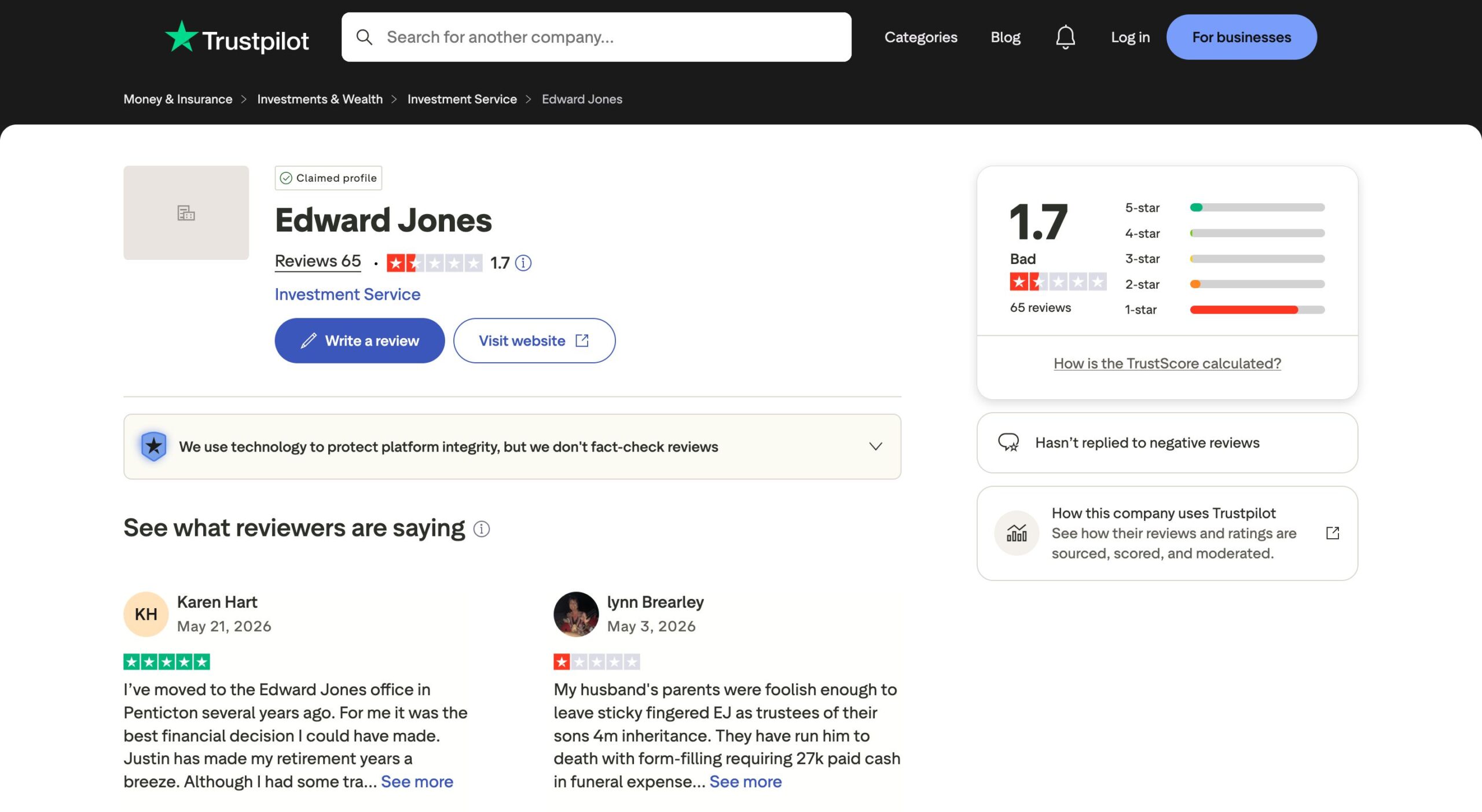
| Trustpilot | ~1.7 / 5 | Small base (~65 reviews); a few glowing advisor reviews, many fee and service complaints |
| ConsumerAffairs | 1.5 / 5 (234 reviews) | ~180 one-star vs. ~21 five-star; profile unclaimed by the company |
| Glassdoor (advisors) | ~3.9 / 5 | Employee satisfaction, separate from client experience |
| ProConsumer | ~2.5 / 5 | Cites regulatory history |
My honest read on these numbers: the gap between the A- at the BBB and the 1.5 to 1.7 on consumer review sites is wide, and that gap tells a story.
People who love Edward Jones almost always love a specific advisor. People who hate it almost always cite fees, slow access to their own money, or trouble reaching anyone. The experience is only as good as the individual you’re matched with.
Better Business Bureau
The BBB lists Edward Jones with an A- rating but, notably, the firm is not BBB-accredited. The file has been open since 1981 for a company in business 104 years.
Two government-action alerts sit on the profile. The recurring complaint themes are difficulty accessing money in accounts and difficulty reaching a representative. The A- score takes a hit specifically because the firm failed to respond to two complaints.
Trustpilot and ConsumerAffairs
On Trustpilot, the aggregate score hovers around 1.7 out of 5, though the review base is small, so I’d weight it lightly.
On ConsumerAffairs, the skew is heavier and the sample larger: a 1.5 out of 5 across 234 reviews, with roughly 180 one-star ratings against about 21 five-star.
The praise, when it comes, centers on attentive individual advisors who hold your hand through retirement and life events.
The complaints cluster around high or opaque fees, delays accessing funds and beneficiary payouts, advisor reassignment without notice, and an unresponsive head office.
The firm’s regulatory record also includes a FINRA restitution of about $4.4 million tied to mutual fund fee-waiver failures and a multistate settlement near $17 million.
Who Edward Jones Genuinely Suits, and Who Should Look Elsewhere

No firm fits everyone, and pretending otherwise wastes your time. Here’s the straight fit analysis.
Edward Jones works well if you:
- Want a real human in a local office you can visit
- Prefer hands-off management and don’t mind paying for guidance
- Value a long-term relationship over rock-bottom cost
- Hold conventional assets and aren’t chasing alternatives
Edward Jones is a poor fit if you:
- Are a cost-conscious do-it-yourselfer who buys index funds
- Want full fee transparency with a published rate card
- Specifically want to own physical precious metals
After those lists, the bottom line: if you value the relationship and accept the cost, Edward Jones delivers what it promises. If your goal is tangible gold or the lowest possible fees, you’re shopping in the wrong store.
Where to Turn If Physical Metals Are Your Goal
If real bullion in a tax-advantaged account is what you’re after, you’ll need a self-directed IRA custodian paired with a precious-metals specialist.
Among the firms often recommended for precious metals retirement accounts, three names come up consistently.
I’ve kept this short and disclosed: the links below may be affiliate placements, and that doesn’t change the honest assessment.
Goldco
Goldco focuses on gold and silver IRAs and is known for strong customer service and an educational, low-pressure onboarding process.
It handles the rollover paperwork and coordinates IRS-approved storage. Minimums tend to sit higher than entry-level competitors, so it suits savers rolling over a meaningful balance.
Augusta Precious Metals
Augusta Precious Metals built its reputation on transparency and one-on-one education, including a web conference that walks you through fees before you commit.
It carries a higher minimum, which makes it a fit for larger accounts. The standout trait is how much it leans into teaching rather than selling.
American Hartford Gold
American Hartford Gold tends to carry a lower entry point, which makes it accessible to savers who want to start smaller.
It offers gold and silver for both IRAs and direct purchase, and it runs a buyback program for liquidity when you eventually exit. That combination appeals to first-time metals buyers.
After these three, a word of caution: any of these involves a self-directed IRA with its own setup, annual maintenance, and storage fees. Read every disclosure and compare total cost before moving retirement money.
Frequently Asked Questions
Q1. Can I Move My Existing Edward Jones IRA Into Physical Gold?
Yes, but not within Edward Jones. You’d open a self-directed IRA with a precious-metals custodian, then request a direct rollover or transfer from your Edward Jones IRA.
A direct trustee-to-trustee transfer avoids the 60-day indirect rollover trap and the tax headaches that come with it.
Q2. Does Edward Jones Buy Back Gold or Precious Metals?
No. Edward Jones is not a metals dealer, so there is no buyback program. Buyback guarantees are a feature of precious-metals companies like American Hartford Gold, not full-service brokerages.
Q3. Is Edward Jones a Fiduciary That Must Act in My Best Interest?
Not across all accounts. Edward Jones is a dually registered broker-dealer and investment adviser. Advisory accounts carry a fiduciary duty, but brokerage accounts operate under Regulation Best Interest rather than a full fiduciary standard. Ask your advisor in writing which standard applies to your specific account.
Q4. How Do Edward Jones Fees Compare to a Precious-Metals IRA Company?
They’re different in kind. Edward Jones charges asset-based advisory fees around 1.35% plus sales charges.
A Gold IRA company charges a flat setup fee, an annual maintenance fee, and a storage fee, often a few hundred dollars a year regardless of balance.
On a large account, flat metals fees can be cheaper; on a small one, percentage-based advisory fees may win.
Q5. Is Edward Jones a Safe and Legitimate Place for My Retirement Money?
Yes, it’s a legitimate, century-old firm. Accounts are protected by SIPC, and the firm is regulated by the SEC and FINRA, where you can check it on BrokerCheck. Legitimacy is not the question. Cost and fit are.
My Final Take on Edward Jones for Gold Investors
Edward Jones is a real, established firm, and it does plenty well for hands-off savers who want a local advisor and don’t mind paying for the relationship.
What it does not do is hold physical gold in a self-directed IRA, full stop. You can get paper gold there through ETFs, funds, or mining stocks, but never the metal itself.
If tangible bullion is your goal, your next step is a self-directed custodian paired with a metals specialist. Compare total fees, read the disclosures, and move slowly with money you can’t afford to gamble.
Goldco Precious Metals
- Goldco Surpasses $2 Billion in Precious Metals Placements
- Over 6,000 Five-Star Ratings on BBB, Trustpilot, and ConsumerAffairs
- Seven-Time Winer on the Inc. 5000 List