
Disclosure: “The owners of this website may be paid to recommend Goldco or other companies. The content on this website, including any positive reviews of Goldco and other reviews, may not be neutral or independent.” Learn More
If you’ve been watching your 401(k) bounce around like a pinball this year, you’ve probably typed “Birch Gold Group review” into Google at some point.
I did the same thing about eight months ago, sitting at my kitchen table with two decades of retirement savings on my mind and a growing distrust of paper assets.
What I found surprised me, and not always in the ways the glossy marketing pages promised. This breakdown covers what works, what doesn’t, and what the company won’t tell you upfront.
A Look Inside the Birch Gold Group Team

Before handing over a single dollar from a retirement account, I wanted to know who actually runs the place. Names matter. Track records matter more.
Headquarters and History
Birch Gold Group started in 2003, originally operating out of Burbank, California. The firm has since shifted much of its administrative work to Des Moines, Iowa, joining the cluster of financial services firms that call the Midwest home.
Twenty-plus years in the precious metals business is a meaningful number when you consider how many competitors have opened, collapsed, and rebranded in that same window.
The leadership picture includes Laith Alsarraf, the founder with a background in technology before pivoting into self-directed retirement accounts. Charles Thorngren has also served in executive co-founder roles, while Phillip Patrick acts as the public-facing president and economic commentator. Adrineh Telime oversees operations and compliance.
This matters because precious metals dealing attracts fly-by-night operators. A firm that has weathered the 2008 crash, the COVID disruption, and multiple gold price cycles has earned at least a baseline of credibility.
The “Information First” Philosophy
Call most gold dealers, and you’ll get a pitch within ninety seconds. Birch does something different: they send you a physical information kit before pushing any transaction.
I received mine in about four business days, a printed booklet covering IRS rules on precious metals IRAs, purity standards, and storage logistics.
Some readers will find this slow. I found it refreshing. A company that wants you educated before you commit tends to attract fewer complaints than one that closes you on the first call.
High-Profile Endorsements

Ben Shapiro serves as the most recognized brand ambassador. Ron Paul, Dan Bongino, Megyn Kelly, and Steve Bannon have also publicly aligned with the firm. Robert Kiyosaki of Rich Dad Poor Dad fame rounds out the financial-side endorsers.
My response to endorsement marketing is usually skeptical. Anyone can pay a celebrity. What matters here is that these figures have ongoing relationships and appear on the company’s educational content, not just one-off ads.
The brand has chosen a clear demographic, conservative-leaning savers worried about inflation and currency debasement, and serves it consistently.
What Makes Birch Gold Different? (Pros and Cons)
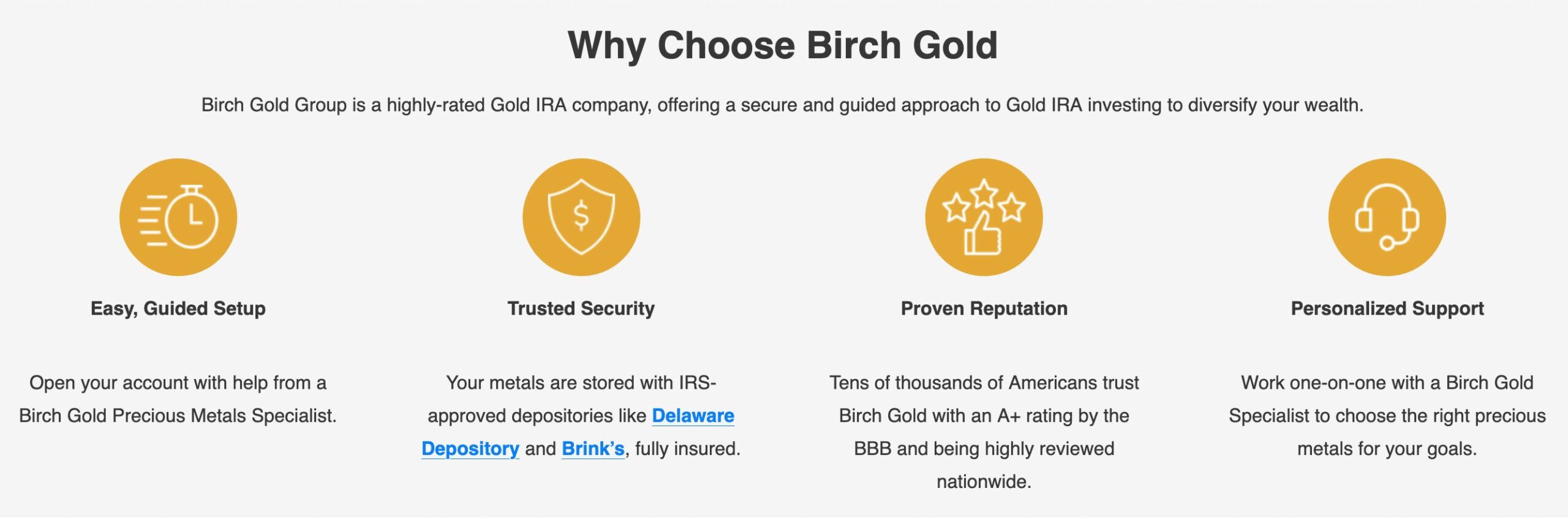
Every gold firm claims to be the best. Few survive a side-by-side comparison. Here’s where Birch actually stands apart, and where it falls short.
The Perks
- Lower entry point than several leading precious metals IRA companies, with a $10,000 minimum that opens the door to mid-tier investors
- Dedicated Precious Metals Specialist assigned to your account rather than a rotating call-center cast
- Four metals offered: gold, silver, platinum, and palladium, when many competitors stop at the first two
- First-year fees waived on rollovers above the $50,000 mark
- Established custodian relationships with Equity Trust Company and STRATA Trust Company
- Buyback program that has earned solid feedback from past customers
The specialist relationship was the part I valued most. Calling and speaking to the same person three weeks later, who remembered my situation, felt closer to a private wealth experience than a commodity transaction.
The Drawbacks
- Premium markups on certain coins can run significantly above spot price, particularly on proof or fixed-mintage editions
- No real-time online dashboard for tracking your holdings the way you’d track a brokerage account
- No physical retail location to walk into for in-person consultations
- Closed weekends, which surprised me when I tried calling on a Saturday
- Buybacks are not legally guaranteed in writing, which is true across the industry but worth knowing
Some buyers have flagged the spread between purchase price and buyback offers on premium coins. Sticking to standard bullion sidesteps most of this issue.
The $10,000 Threshold: Who Can Invest?
The $10,000 minimum sits well below several major competitors. Augusta Precious Metals requires $50,000. Goldco asks for $25,000.
Birch’s lower bar matters for the saver with a modest IRA balance who still wants metals exposure without liquidating every other position.
That said, $10,000 isn’t nothing. Annual fees of roughly $200 represent two percent of a $10,000 account but only 0.4 percent of a $50,000 account.
The math favors larger commitments. For accounts under $25,000, the fee drag deserves a hard look before signing paperwork.
Birch Gold’s Catalog: Gold, Silver, Platinum, and Palladium
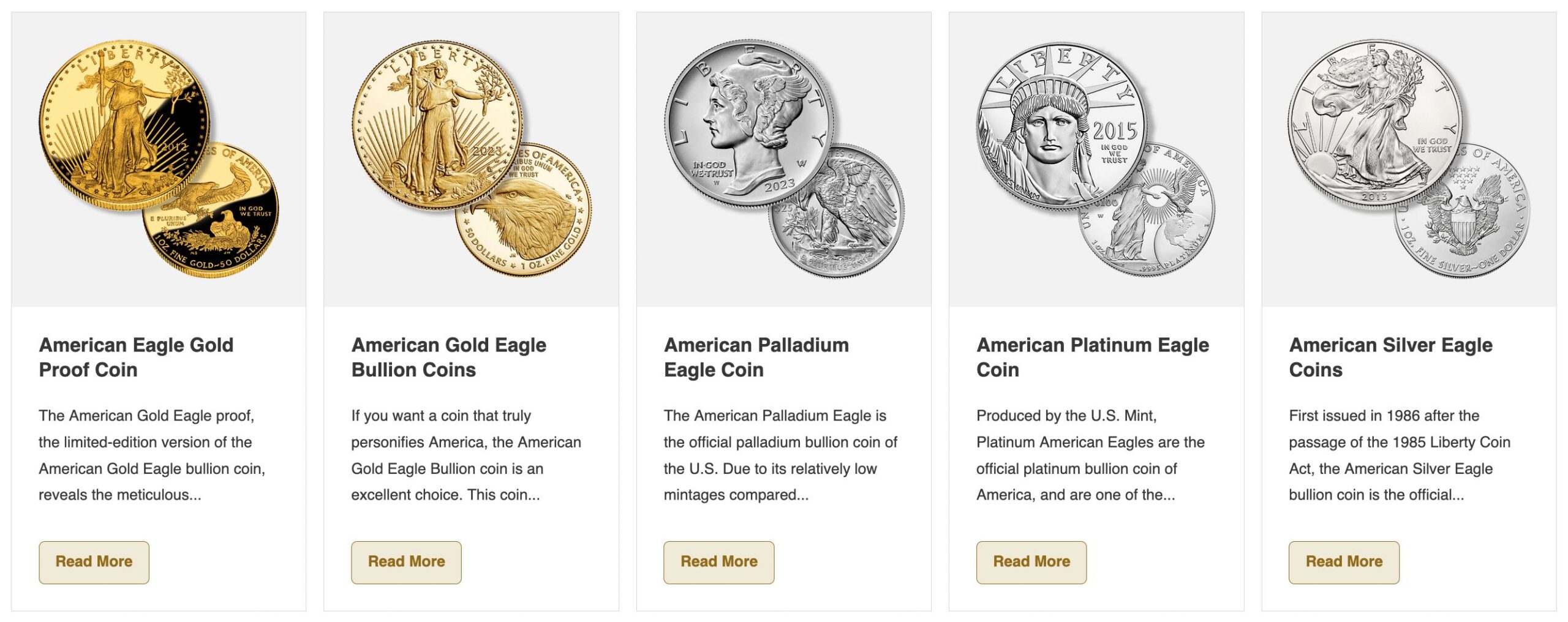
The product list goes beyond what most retirement-focused dealers offer. Variety here serves a practical purpose: different metals respond differently to economic conditions.
IRA-Approved Options
The IRS sets strict purity requirements under IRC Section 408(m). Gold must hit 99.5 percent purity, silver 99.9 percent, and platinum and palladium 99.95 percent. Birch’s IRA-eligible inventory includes:
- American Gold Eagle coins (grandfathered despite 22-karat purity)
- American Gold Buffalo coins
- Canadian Gold Maple Leaf coins
- Silver American Eagles
- Silver Canadian Maple Leafs
- Approved gold, silver, platinum, and palladium bars from accredited mints
The Eagle exception exists because the U.S. government guarantees the weight and content, even though the alloy contains copper for durability.
Beyond Gold and Silver
Platinum and palladium availability sets Birch apart from many competitors who treat these as afterthoughts.
Both metals carry industrial demand from the automotive sector, particularly catalytic converters, giving them a different risk profile than pure monetary metals like gold.
A balanced precious metals allocation might split across two or three of these metals rather than concentrating in gold alone.
Numismatic and Proof Coins
For non-IRA purchases with physical home delivery, Birch offers collector coins and proof editions. These carry higher premiums and depend on numismatic value rather than pure metal content.
I’d approach this category cautiously. The collector market has its own logic, and the resale window can be narrower than standard bullion.
Fees and Maintenance Costs: What You’ll Actually Pay
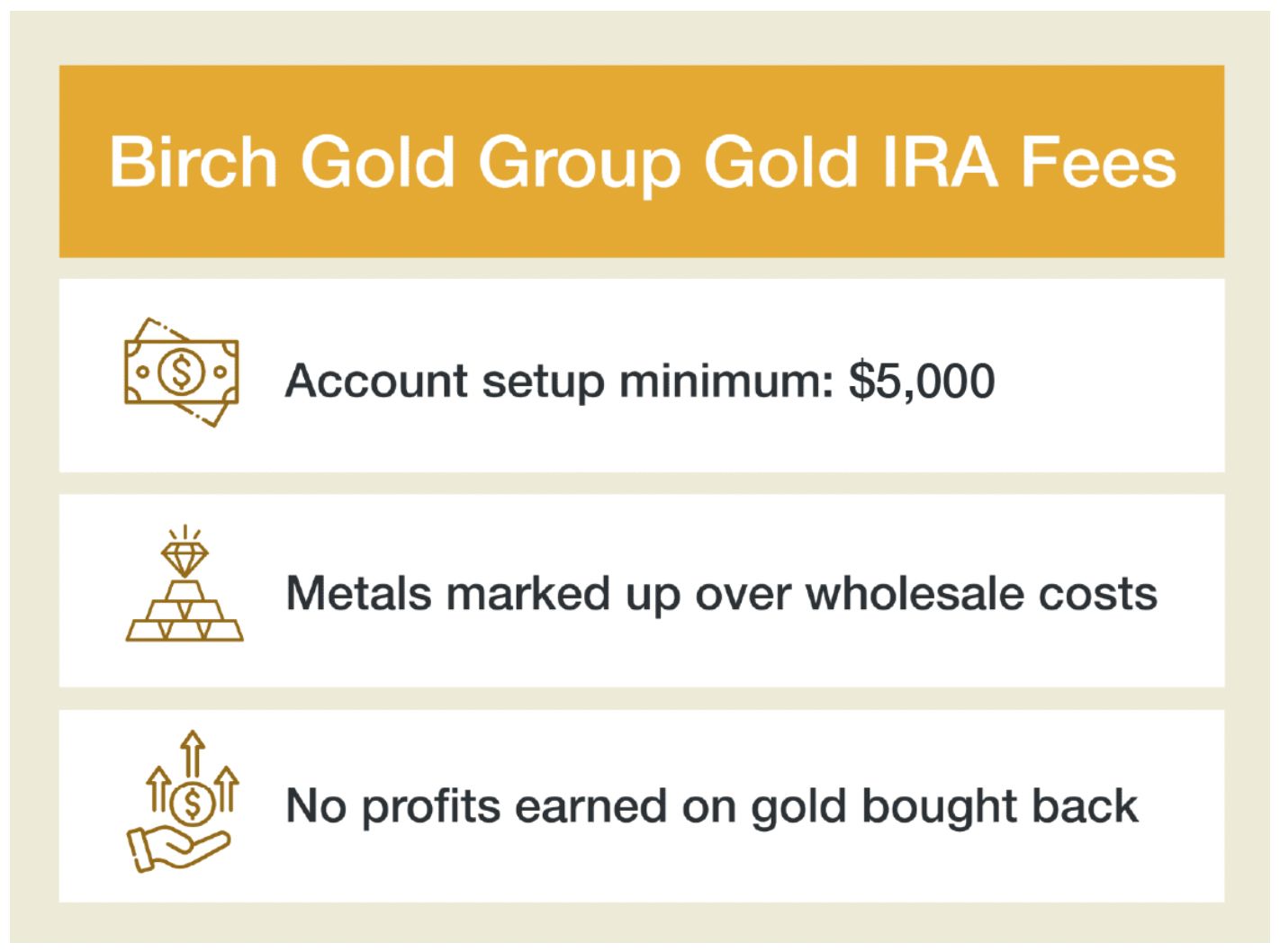
The fee structure is flat rather than percentage-based, which becomes a meaningful advantage as account size grows.
The Setup Costs
Opening a new account triggers two one-time charges:
- $50 account setup fee
- $30 wire transfer fee
That’s $80 to get your account funded and operational. Compared to the typical financial-services account setup, this is reasonable.
Ongoing Annual Fees
- $100 annual management fee paid to the custodian
- $100 annual storage and insurance fee at the depository
Total ongoing cost: roughly $200 per year. This number stays the same whether your account holds $15,000 or $500,000. A larger balance dilutes the percentage impact significantly.
The “Free Gold” Promotions
Transfers above $50,000 typically qualify for waived first-year fees. Larger rollovers can unlock promotional silver bonuses ranging from a few thousand dollars up to $25,000 in metal value, depending on the campaign window.
These offers shift over time, so confirm current terms during your consultation rather than relying on what an old article (including this one, eventually) describes.
How to Start Your Account With Birch Gold Group
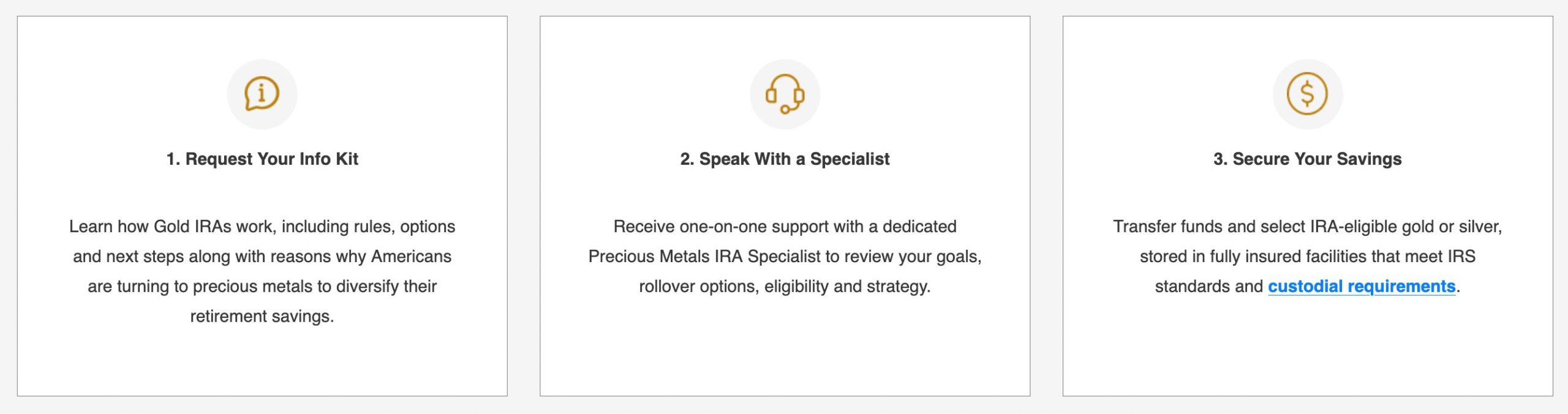
The process took me about three weeks from initial call to confirmed metal storage. Your timeline depends mostly on how quickly your current 401(k) administrator releases funds.
Step 1: The Initial Consultation
A specialist walks through your retirement situation, current account types, and goals. Expect questions about your time horizon, risk tolerance, and existing portfolio mix. No transaction happens on this call. You’ll receive the physical information kit afterward.
Step 2: Paperwork and Funding
This is where Birch handles the heavy administrative work. They coordinate with your existing custodian to execute a direct trustee-to-trustee transfer, which avoids the tax penalties triggered by an indirect rollover.
The IRS guidance on rollovers is worth reading before you start, so you understand the sixty-day rule and one-rollover-per-year limits.
Step 3: Picking Your Metals
Once funds land in your new self-directed IRA, you choose specific coins and bars. Your specialist provides current pricing and walks through the tradeoffs between standard bullion (better liquidity, lower premium) and specialty coins (potential numismatic upside, higher spread).
Step 4: Finalizing the Transfer
The custodian executes your purchase. Metals ship from the mint or wholesaler directly to your chosen IRS-approved depository.
You receive documentation confirming the exact items, weights, and storage location. You never physically handle the metal during this process, which is a federal requirement for IRA-held assets.
Keeping Your Metal Safe: Storage and Custodians
Physical metal sitting in a vault you can’t see requires trust. The structure here is designed to keep that trust verifiable.
Partner Custodians
Birch works with established self-directed IRA custodians:
- Equity Trust Company, based in Ohio, manages over $39 billion in assets
- STRATA Trust Company, a Texas-based custodian with deep experience in alternative assets
Both firms operate under state banking regulations and undergo regular audits. The custodian handles paperwork, IRS reporting, and the administrative compliance that keeps your account in good standing.
Vaulting Locations
The metal itself sits at major depositories:
- Brink’s Global Services, the largest non-governmental holder of precious metals worldwide
- Delaware Depository, which carries a $1 billion insurance policy through Lloyd’s of London
- International Depository Services
- Texas Bullion Depository
You can choose segregated storage, where your specific coins and bars sit in a dedicated space with your name on them, or non-segregated storage, where your holdings are pooled with others of the same type. Segregated costs more but eliminates any ambiguity about which physical pieces are yours.
The Commodity Futures Trading Commission has published warnings about home storage IRA schemes, where companies suggest investors can keep IRA metals in personal safes. Don’t do this. The IRS treats it as a distribution, triggering taxes and potential penalties.
Selling Your Metals Back: How the Buyback Works
When you need to liquidate, Birch offers a buyback program with right of first refusal. You aren’t obligated to sell to them, but they provide a quote based on current market conditions.
A few realities to understand:
- No precious metals dealer can legally guarantee a buyback in writing. This is industry-wide, not a Birch-specific issue
- Standard bullion typically liquidates close to spot price
- Premium and proof coins can show a meaningful spread between purchase and buyback
- The process usually completes within a few business days
Past customers have generally rated the buyback experience favorably. The smartest hedge against future liquidity problems is choosing standard bullion over premium coins at the purchase stage.
Checking the Track Record: Ratings and Real Complaints
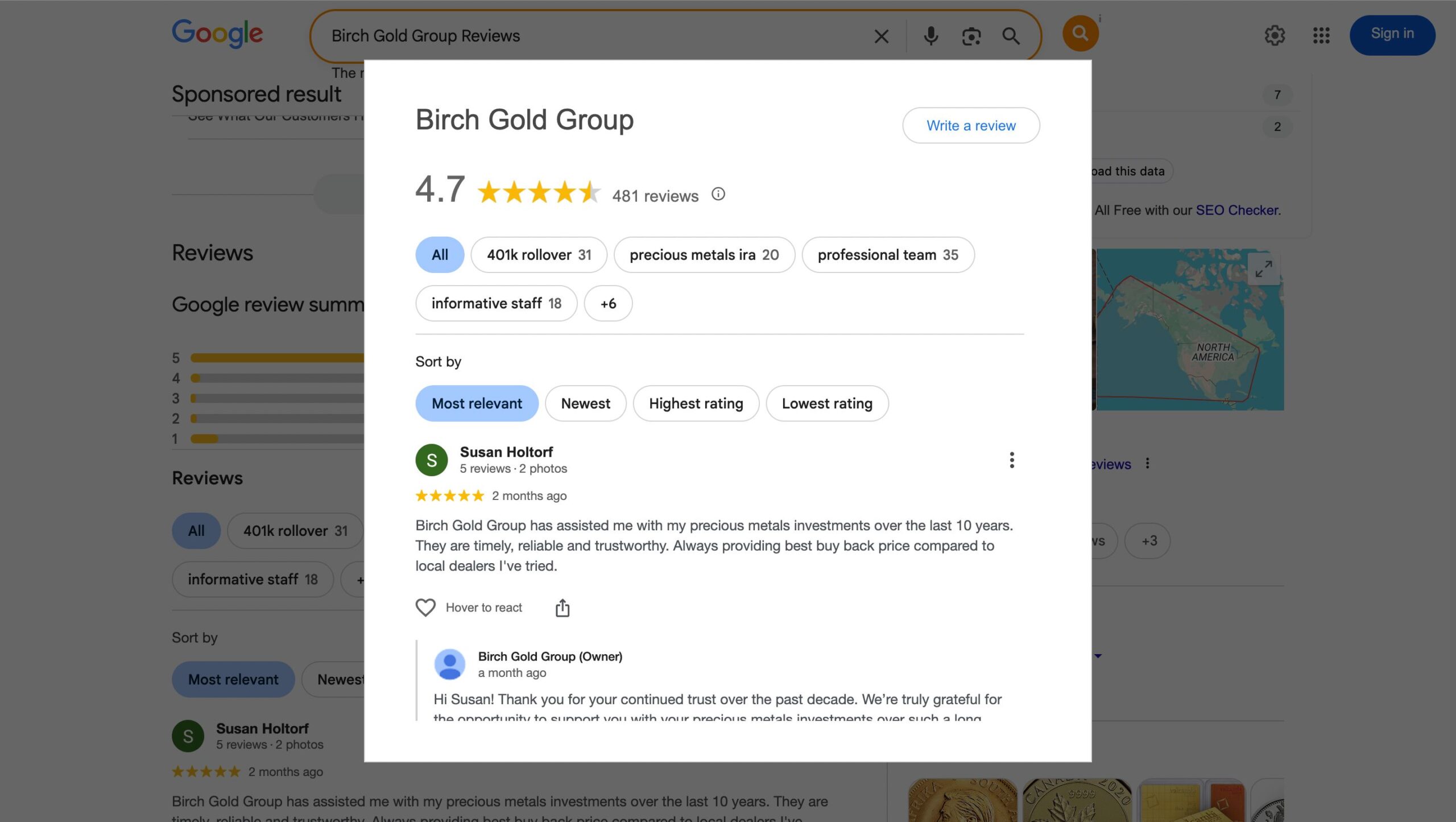
Public ratings and complaint patterns reveal more than any company’s marketing copy.
Third-Party Scores
- Better Business Bureau: A+ rating, accredited since 2011
- Business Consumer Alliance: AAA rating
- Trustpilot: approximately 4.4 out of 5 across nearly 300 reviews
- Google Reviews: 4.7 out of 5 across nearly 500 reviews
- ConsumerAffairs: 4.3 out of 5 across over 200 reviews
These ratings put Birch in the upper tier of leading precious metals IRA companies, though no firm of this size operates without complaints.
Addressing Common Complaints
Honest review means looking at what goes wrong, not just what goes right. The recurring criticisms include:
- Rollover timing. Some customers report waiting longer than expected for funds to move from prior custodians. Most of this delay sits with the prior custodian, not Birch
- Price spread on premium coins. A few reviewers have flagged significant gaps between purchase prices and buyback offers on specialty coins
- Phone-based process. Investors who prefer pure digital interaction have noted the lack of a self-service online platform
- Sales energy. A small number of reviews mention feeling pressured during follow-up calls, though most describe the opposite experience
None of these complaints rise to the level of fraud or systemic misconduct. They’re operational frictions that come with the territory.
Is Birch Gold Group the Right Fit for Your Portfolio?
Birch fits best for:
- Mid-tier investors with $25,000 to $250,000 to allocate to metals
- Savers who want a real human relationship rather than an app
- People specifically interested in platinum or palladium exposure
- Buyers who value education and a slower, consultative process
- Conservative investors looking to hedge against currency and market risk
Birch fits less well for:
- Investors with under $15,000 to commit, where fees eat too much of the balance
- Active traders who want real-time dashboards and same-day transactions
- Buyers chasing the absolute lowest premium over spot price
- People uncomfortable with phone-based account management
The honest answer is that no single gold company is right for everyone. The question is whether the specific tradeoffs match your situation.
Frequently Asked Questions
Q1. Is Birch Gold Group a Scam or Legit?
Birch Gold Group is a legitimate, accredited business. A+ BBB rating since 2011, AAA from BCA, twenty-plus years of operation, partnerships with major custodians and depositories, and tens of thousands of customers all point to a real operation.
Like any company, it has critics and the occasional unhappy customer, but the structural indicators of legitimacy are all present.
Q2. How Long Does It Take to Move My 401(k) to a Birch Gold IRA?
Most rollovers complete within two to three weeks. The main variable is your current 401(k) administrator’s processing speed.
Birch handles the paperwork on their end quickly. Plan for a few weeks of waiting, and don’t rush the prior custodian into mistakes.
Q3. Can I Take Physical Possession of My Gold?
Not while it’s held inside an IRA. The IRS requires IRA-held metals to sit with an approved depository.
You can take a distribution, which means moving the metal out of the IRA, but this triggers taxes and potentially penalties depending on your age.
For metals, you want at home, buy them outside the retirement account structure as a direct purchase.
Q4. Who Actually Owns the Company?
Laith Alsarraf founded Birch Gold Group and remains the central ownership figure. The leadership team includes co-founder Charles Thorngren, President Phillip Patrick, and COO Adrineh Telime. The company is privately held rather than publicly traded.
Final Thought
Birch Gold Group earns its A+ rating through consistency, not marketing hype. Twenty-plus years in business, a real specialist relationship, four metals to choose from, and a $10,000 entry point make it a solid option for retirement savers who want physical gold without a Fortune-500-sized account.
Request the free information kit, read it carefully, and book a no-obligation call before you commit. Your future self will appreciate the homework.
Goldco Precious Metals
- Goldco Surpasses $2 Billion in Precious Metals Placements
- Over 6,000 Five-Star Ratings on BBB, Trustpilot, and ConsumerAffairs
- Seven-Time Winer on the Inc. 5000 List