
Disclosure: “The owners of this website may be paid to recommend Goldco or other companies. The content on this website, including any positive reviews of Goldco and other reviews, may not be neutral or independent.” Learn More
You search “is Provident Metals legit,” and within ten seconds you hit a wall: an A+ Better Business Bureau badge sitting right next to a 1.6-star Trustpilot score. One number says “trust us,” the other says “run.” So which is real? Both are.
This Provident Metals review is my attempt to dig through the policies, the ownership history, and every review site I could find to tell you what those conflicting numbers actually mean for your money.
The Two-Sided Reputation You’ll Run Into First
I went into this expecting a clear answer. I didn’t get one, and neither will you at first glance.
Here’s the split that confuses everyone. The BBB hands Provident an A+ letter grade and has accredited the company since October 2019. Yet the same BBB page shows a customer-review average of 1.5 out of 5 stars. Over on Trustpilot, it’s 1.6 out of 5 from 3,689 reviews. Then you flip to Provident’s own site and see a 4.9 Shopper Approved seal glowing back at you.
My job here isn’t to pick the flattering number or the scary one. It’s to explain why both are honest, where each comes from, and what the pattern predicts for someone placing a first order.
What this review won’t do is pretend Provident is either a scam or a flawless dealer. It’s neither. It’s a long-operating, legally legitimate bullion seller with a real and documented service-quality problem. Let’s separate those two things.
Where Provident Metals Came From and Who Owns It Now
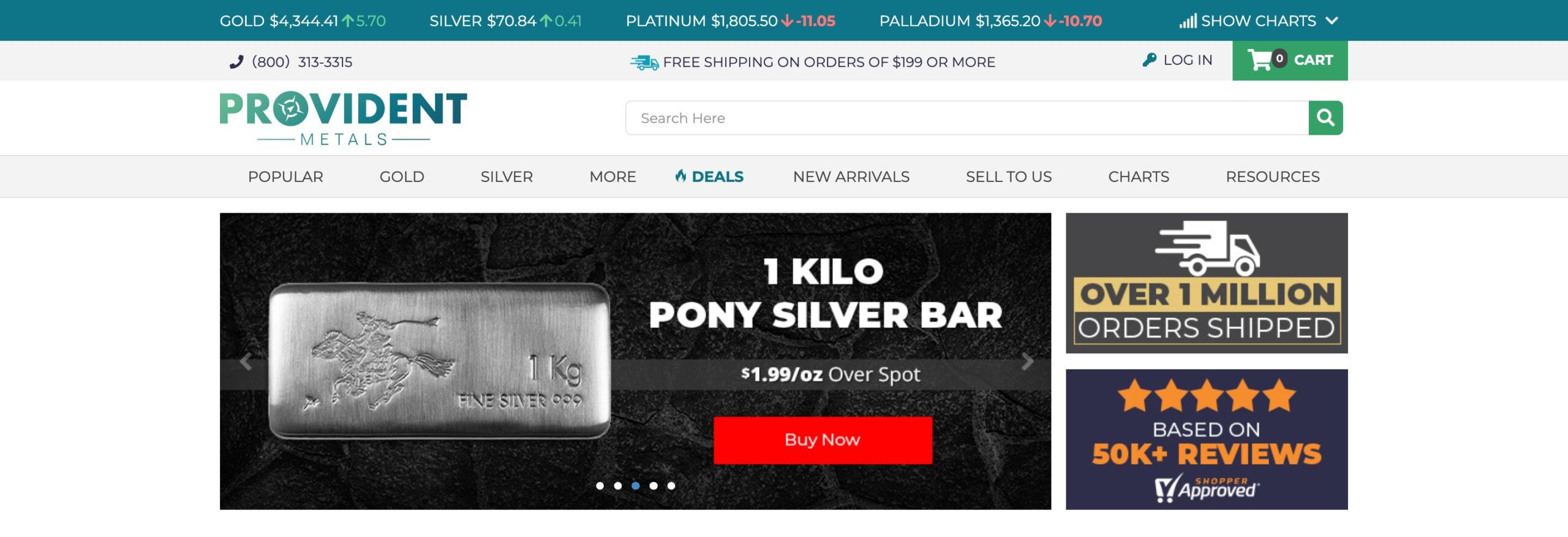
Most reviews skip this part, and that’s a mistake. Who actually fulfills your order matters more than the logo on the box.
The short version: the brand you’re buying from today is operated by JM Bullion, which itself belongs to a publicly traded company called A-Mark Precious Metals. Provident still has its own website and branding, but the back-end machinery isn’t independent anymore.
From a 2009 Startup to a JM Bullion Brand
Joe Merrick launched Provident Metals in Dallas in 2009 as an online-only bullion shop. The pitch was simple and a little folksy: be “The People’s Bullion Dealer,” a place built around what customers asked for rather than what a wholesaler wanted to push.
That positioning stuck. The proprietary coin series and aggressive pricing both trace back to that early identity. For a few years, Provident was a scrappy independent in a market dominated by bigger names.
The Ownership Trail: Dillon Gage, JM Bullion, and A-Mark
Then the brand changed hands three times in four years:
- 2017: Bullion wholesaler Dillon Gage acquired Provident.
- 2019: JM Bullion bought it, with the deal announced publicly that October.
- 2021: A-Mark Precious Metals, which trades on the NYSE, acquired JM Bullion in a deal that valued JM Bullion at roughly $174 million.
So when you place an order with Provident, the help center, the policies, and the fulfillment are run through JM Bullion’s infrastructure. That’s good news for financial stability, since A-Mark is a regulated public company.
It’s also why Provident’s service patterns tend to mirror JM Bullion’s rather than the independent shop it once was.
The People Listed at the Top
The leadership listed on Provident’s BBB file reads like the JM Bullion roster, which makes sense:
- Michael Wittmeyer — CEO
- Tom Fougerousse — Vice President of Operations
- Robert Byerley — CFO
Leadership continuity tells you something about reliability. A dealer that keeps the same hands on the wheel after an acquisition usually keeps its processes intact.
Here, the JM Bullion team runs both brands, so your experience with Provident will look a lot like a JM Bullion experience, for better and worse.
What You Can Actually Buy There
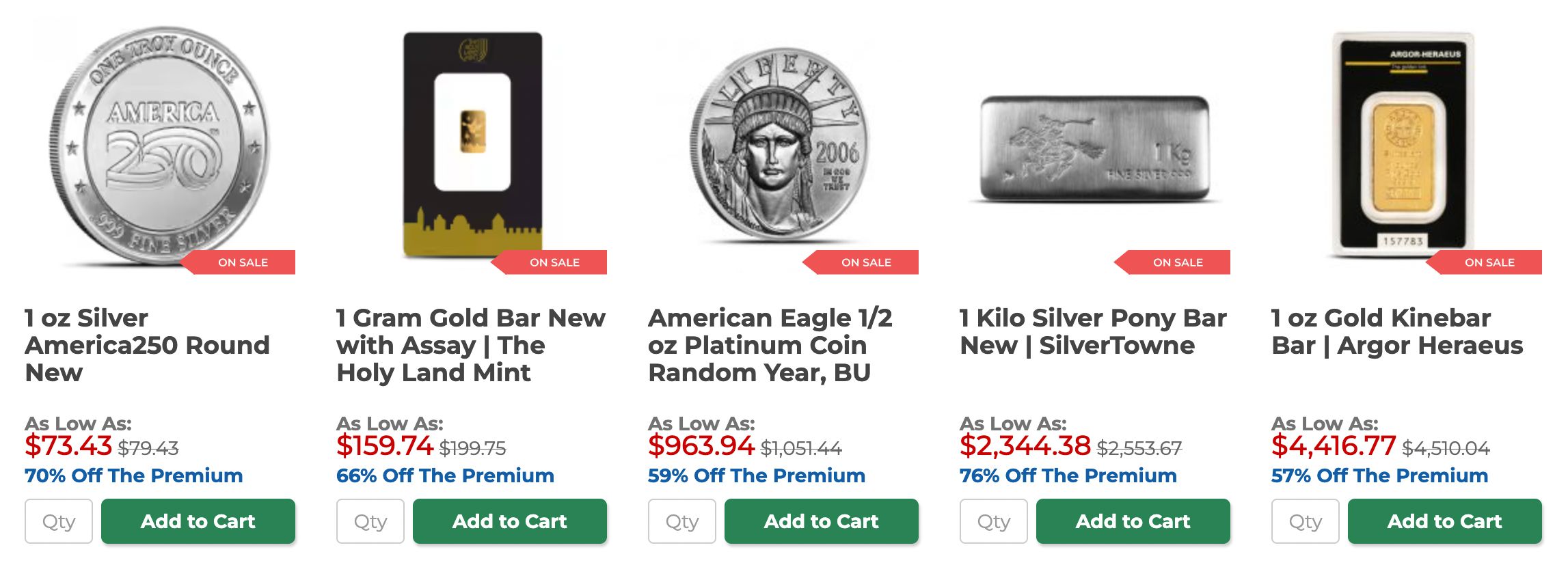
A catalog list is boring, so let me tell you what makes their shelf different from the next bullion site.
Provident carries the full metals spread plus a set of in-house coin series you genuinely won’t find at most rivals. That second part is the interesting one.
The Core Metals Lineup
The standard inventory covers what you’d expect:
- Gold: American Eagles, Buffalos, Pre-33 coins, Canadian Maples, Britannias, Krugerrands, Pandas, plus Goldbacks and a small jewelry line.
- Silver: American Eagles in multiple finishes, 90% junk silver, Maples, Libertads, Kookaburras, and silver notes.
- Platinum and palladium bullion bars and coins.
- Copper rounds, bars, and even copper wheat pennies.
Both sovereign-mint and private-mint products are well represented, so you can build a stack across price points and recognizability.
The In-House Series That Set Them Apart
This is Provident’s signature. They produce original series like Zombucks, the Provident Prospector, and Egyptian Gods, plus licensed NBA, MLB, and Star Wars rounds.
These are fun, and collectors like them. One honest caution: proprietary and licensed rounds usually resell closer to spot than recognized sovereign coins. If resale liquidity matters to you, treat these as the dessert, not the main course.
Supplies, Rare Coins, and Notes
Beyond metals, you’ll find capsules, tubes, storage cases, and coin-care products, along with numismatic rare coins and the Goldback/Silverback notes.
It rounds out the range, so you can store and protect what you buy in one checkout. Most buyers won’t need the supplies, but having them on hand saves a second order.
Pricing, Premiums, and the Discounts That Actually Move the Needle
Provident pitches itself as the budget option, and the numbers mostly back that up if you pay the right way.
The headline truth: how you pay changes your real price more than which product you pick. Card buyers pay one number, wire buyers pay a meaningfully lower one.
The Payment-Method Discounts (4% and 3%)
Here’s the discount structure that actually matters:
- Bank wire, ACH, eCheck, personal check, cashier’s check, money order: 4% cash discount.
- Bitcoin: 3% discount.
- PayPal, credit/debit cards, Apple Pay, Google Pay: no discount.
On a $5,000 silver order, that 4% is $200 back in your pocket just for wiring funds instead of swiping a card. Skip the card unless you truly need the float.
How Their Premiums Compare to Sister Brand JM Bullion and Rivals
On sticker pricing, Provident often undercuts both APMEX and its own sibling JM Bullion, and it runs close to SD Bullion on common silver.
Where it doesn’t win is consistency and fulfillment. Industry observers note Provident’s service and shipping speed tend to lag JM Bullion, APMEX, and SD Bullion, even when the price is lower.
You’re trading a little reliability for a little savings. Whether that trade is worth it depends entirely on your patience.
How Ordering, Paying, and Shipping Really Work
This is the transactional reality, including the clauses that catch first-timers off guard.
Accepted Payments and the Order-Lock Rule
The payment menu is wide:
- Bank wire ($500 to $500,000)
- ACH, eCheck, personal check, cashier’s check, money order (up to $100,000)
- Bitcoin (up to $100,000)
- PayPal (up to $60,000)
- Credit/debit, Apple Pay, Google Pay (up to $50,000)
Here’s the part that bites people. The moment you confirm an order, it becomes a binding agreement locked to that day’s metal price. If you back out, the Market Loss Policy kicks in, and you can owe the difference if prices moved against the company.
Payment must be wired or postmarked within one to two business days. Read that clause before you click confirm, not after.
Shipping Speed, Free-Shipping Threshold, and Insurance

Shipping terms are straightforward on paper:
- Free shipping on orders of $199 or more; flat $9.95 below that.
- US only, all 50 states, no international delivery.
- Typical handling of 5 to 10 business days after good funds clear.
- Fully insured, discreet, unmarked packaging.
- Orders over $1,000 require signature confirmation.
That 5-to-10-day window is the friction point. Faster competitors get product out the door quicker, and a chunk of Provident’s negative reviews trace straight back to this timeline. Plan for the slow end, and you won’t be disappointed.
The Return Window and What’s Non-Refundable
Returns are tight:
- You have 5 business days from delivery to request a return or exchange.
- Items must be in original packaging and condition.
- Shipping charges are non-refundable.
- Every return is subject to the Market Loss Policy.
Returns must be started by phone, not email. The Market Loss clause means a return isn’t a clean refund if metal prices dropped while you held the item. This is standard for bullion dealers, but it surprises people coming from regular retail.
Selling Your Metals Back to Provident

Plenty of dealers stay quiet about buybacks. Provident at least publishes a clear path, which I appreciate.
The Three-Step Lock, Ship, and Get Paid Process
The buyback runs in three moves:
- Call to lock your sell price.
- Ship your items, postmarked by the next business day.
- Get paid within three business days of Provident receiving the metal.
It’s simple, and locking the price up front protects you from a mid-shipment price swing. The catch is the next-business-day postmark requirement, so don’t lock a price on a Friday if you can’t mail Monday.
The $3,000 Minimum and Payout Options
A few hard limits apply:
- $3,000 minimum for the whole sale order.
- ACH payout: free.
- Paper check: $50 fee.
- Wire transfer: $25 fee.
If you’re sitting on a small stack, the $3,000 floor rules you out. For larger holdings, choose ACH and the buyback costs you nothing in fees.
The Precious Metals IRA Option and Its Real Limits

Provident is mainly a direct bullion dealer, but it does offer a self-directed precious metals IRA for the retirement-minded slice of readers.
How Setup, Funding, and Custodians Work
The setup follows the standard self-directed path: open the account, fund it through a rollover or transfer, then buy IRA-eligible metals.
Provident refers customers to custodians like New Direction Trust Company, with depository options such as First State Depository.
One rule trips up newcomers every time: you cannot take the metals home. IRS rules require IRA metal to ship to an approved depository, not your doorstep. That’s not a Provident quirk; it’s federal law, and any dealer telling you otherwise should worry you.
Storage, Fineness Rules, and Insurance
Storage runs through vaults in Las Vegas and Dallas, insured by Lloyd’s of London. Choosing the Dallas vault can trim shipping costs.
The fineness minimums follow IRS standards:
- Gold: .995 (the American Gold Eagle is exempt)
- Silver: .999
- Platinum: .9995
- Palladium: .9995
There’s no special IRA minimum beyond Provident’s standard $100 order floor. The IRA program is competent but unremarkable; dedicated Gold IRA specialists offer more guidance, while Provident treats it as an add-on to its bullion business.
What the Third-Party Review Sites Really Say
This is the section you came for. Let’s lay every score on the table and then explain the gap honestly instead of cherry-picking.
BBB: An A+ Grade That Hides a 1.5 Customer Score
Here’s the trap. Provident’s BBB profile shows an A+ letter grade and accreditation since October 28, 2019. Right below it sits a customer-review average of 1.5 out of 5 from a handful of reviews, plus 14 complaints in three years.
People assume the A+ means customers are happy. It doesn’t. The BBB letter grade measures things like complaint response, time in business, and transparency, not whether buyers loved their experience.
The company answered 9 of 14 complaints and resolved 5. So the A+ reflects a responsive business; the 1.5 reflects unhappy reviewers. Two different yardsticks.
Trustpilot and Yelp: The Critical End of the Spectrum
The independent platforms are rough:
- Trustpilot: 1.6 out of 5 from 3,689 reviews.
- Yelp: 2.6 out of 5 from 42 reviews.
The recurring complaints cluster tightly: orders cancelled after payment was accepted, slow shipping, and disputes over refunds and Market Loss fees.
One Trustpilot reviewer suspected an order was cancelled because gold rose after the sale locked. These themes repeat enough that I take them seriously.
Shopper Approved and Google: The Glowing End
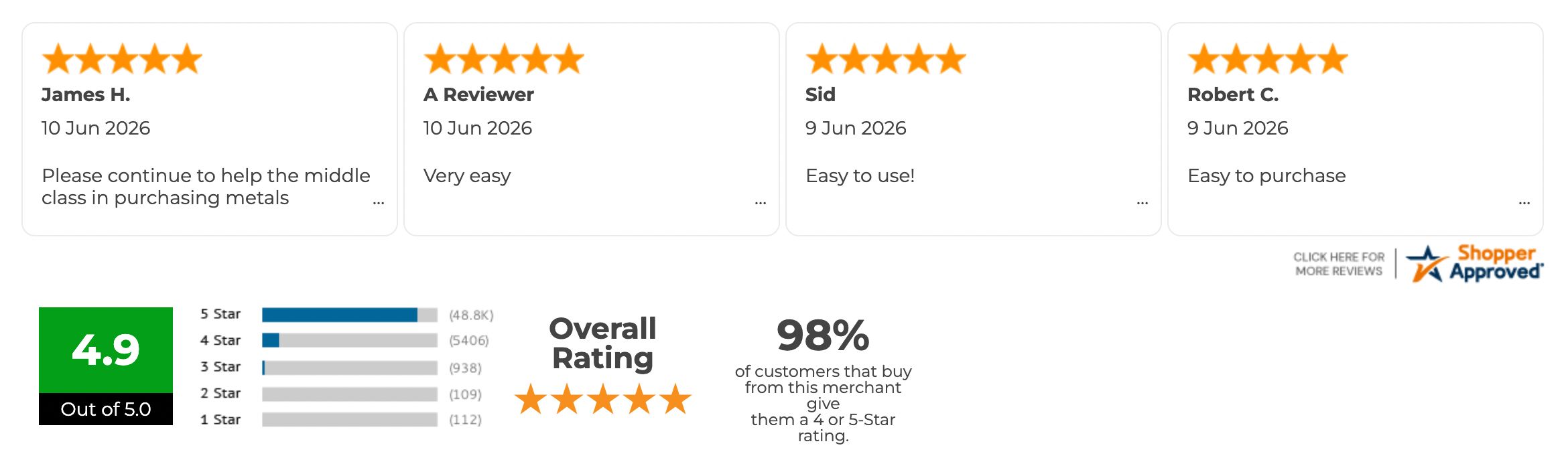
Then you flip to the other side of the ledger:
- Shopper Approved: 4.9 out of 5 from 55,390 reviews.
- Google: 4.9 out of 5 from 3,084 reviews.
These are real too, and the volume is enormous. The praise centers on low pricing, the payment discounts, free shipping over $199, and the unique product series. Tens of thousands of buyers got exactly what they paid for and said so.
Making Sense of the Gap
So why the chasm? The answer is in how each platform collects reviews.
- Shopper Approved prompts every verified buyer right after purchase, capturing the silent majority who had a fine experience.
- Trustpilot, Yelp, and BBB are open platforms people seek out, and humans seek them out far more often to complain than to praise.
Here’s the honest read. The 4.9 scores tell you most orders go through fine. The 1.6 scores tell you that when something goes wrong, the experience can be genuinely frustrating, and the cancelled-order-after-payment pattern shows up too often to dismiss.
Neither number is fake. Weight the high-volume verified scores for “will my order probably arrive,” and weight the complaint platforms for “what happens if it doesn’t.”
Among the safest online gold dealers, the ones with consistent scores across both platform types earn more trust, and that consistency is exactly what Provident lacks.
Who Provident Metals Is Right For (and Who Should Skip It)
A single thumbs-up or thumbs-down would be dishonest here. The right answer depends on what kind of buyer you are.
A Good Fit If You’re Price-Driven and Detail-Oriented
Provident makes sense if you:
- Care most about the lowest premium and will pay by wire or check to grab the 4% discount.
- Read return and Market Loss policies before clicking confirm.
- Can wait the full 5-to-10-day shipping window without anxiety.
- Want the unique in-house series for a collection.
If that’s you, the savings are real and the documented complaints likely won’t touch you. Patient, careful buyers tend to walk away satisfied.
Look Elsewhere If You Need Hand-Holding or Fast Fulfillment
Skip Provident if you:
- Want fast shipping and quick, responsive support.
- Are placing a large first-time order and feel nervous.
- Need a dedicated Gold IRA specialist to guide you.
- Hate the idea of a binding order locked to a market-loss clause.
For those buyers, APMEX or SD Bullion deliver a smoother ride, often worth the slightly higher premium. Peace of mind has a price, and sometimes it’s worth paying.
Frequently Asked Questions About Provident Metals
Q1. Is Provident Metals the Same Company as JM Bullion?
Effectively, yes. JM Bullion acquired Provident in 2019, and A-Mark Precious Metals bought JM Bullion in 2021.
Provident keeps its own brand and website, but the help center, policies, and fulfillment run through JM Bullion’s systems.
Q2. Why Is Provident’s Trustpilot Score So Low if Its BBB Rating Is A+?
They measure different things. The BBB A+ grade reflects complaint response, transparency, and time in business.
The Trustpilot 1.6 reflects self-selected customer reviews, which skew negative because unhappy buyers post far more than happy ones. Both numbers are accurate.
Q3. Does Provident Metals Charge a Fee to Sell My Metals Back to Them?
The buyback itself has no commission, but payout method carries a fee: ACH is free, a paper check costs $50, and a wire costs $25. There’s also a $3,000 minimum for the whole sale order.
Q4. How Long Does Provident Metals Actually Take to Ship an Order?
Plan on 5 to 10 business days after your payment clears, and longer if you pay by personal check, since those are held several days first. Slow shipping is the single most common complaint, so set expectations accordingly.
Q5. Can I Take Physical Possession of Metals Held in a Provident IRA?
No. IRS rules require IRA metals to be stored at an approved depository, not at home. Provident vaults IRA metal in Las Vegas or Dallas under Lloyd’s of London insurance. You take possession only when you take a distribution.
Final Verdict
Is Provident Metals legit? Yes. It’s a long-operating dealer, owned by NYSE-listed A-Mark and run by the JM Bullion team, with an A+ BBB grade and over a million orders shipped. The legitimacy question is settled.
But legitimacy and a smooth experience aren’t the same thing. The 4.9 merchant scores prove most orders arrive fine; the 1.6 independent scores prove that when they don’t, it can get ugly.
If you’re price-driven and patient, buy with confidence. If you need speed and hand-holding, pay a bit more elsewhere.
Goldco Precious Metals
- Goldco Surpasses $2 Billion in Precious Metals Placements
- Over 6,000 Five-Star Ratings on BBB, Trustpilot, and ConsumerAffairs
- Seven-Time Winer on the Inc. 5000 List