
Disclosure: “The owners of this website may be paid to recommend Goldco or other companies. The content on this website, including any positive reviews of Goldco and other reviews, may not be neutral or independent.” Learn More
A polished website and an A+ BBB badge sit next to a 3.2 Trustpilot score and a stack of angry payment-hold posts. That gap is exactly why I dug into this dealer before risking a dollar.
I wanted to know whether the friction people complain about is a scam signal or just clumsy fulfillment. Here is what I found after checking the records, the ratings, and the fine print.
The Real Question Behind “Is Bullion Exchanges Legit?”
Most buyers land on this question already rattled. You see a slick storefront, real Manhattan address, and an A+ accreditation from the Better Business Bureau, then you scroll into a pile of one-star reviews about held funds and slow boxes. Both things look true at once.
So this is not a cheerleading piece, and it is not a takedown. My goal is to reconcile that contradiction with actual numbers and policies, then tell you plainly who should buy here and who should walk.
The short version: yes, Bullion Exchanges is a real, licensed dealer that has been moving metal for over a decade. The complaints are mostly about how the buying process feels, not about whether you get your gold. The rest of this review unpacks that difference.
A Diamond District Dealer, Not a Mail-Order Startup
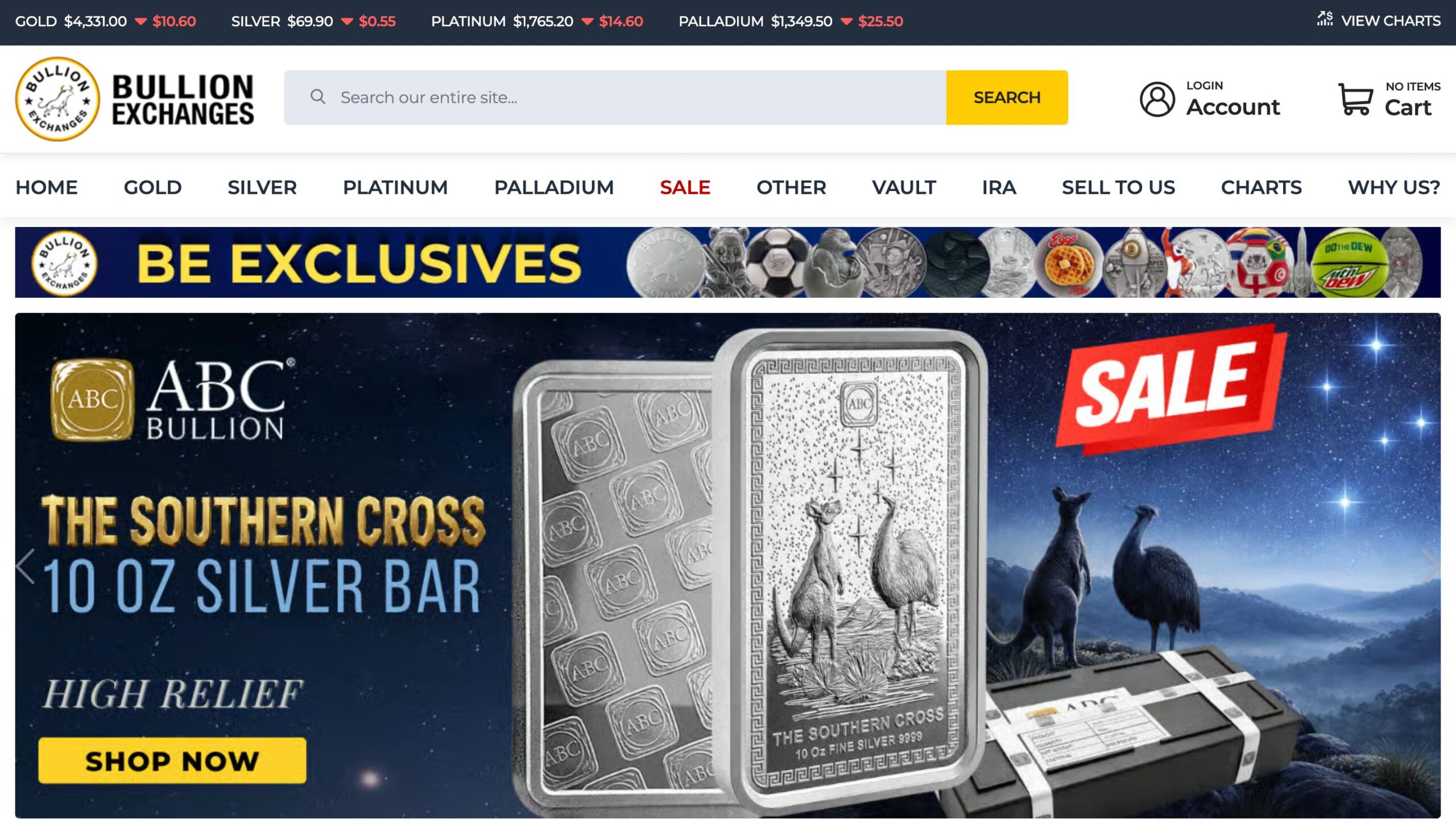
The thing that separates this company from a faceless web shop is a brick-and-mortar counter you can actually stand at.
They have operated since late 2012 out of 30 West 47th Street, Store 1, in Manhattan’s Diamond District, the same block where dealers have traded metal and stones for generations.
Third-party records credit Eric (Ernest) Gozenput as the founder, and the business grew from a walk-in coin shop into a nationwide online retailer registered as Bullion Exchange, LLC. State incorporation records put the start date at November 2012, with operations beginning that December.
A physical store matters for a reason most people overlook. A scammer does not sign a 47th Street lease, install XRF testing machines, and invite the public through the door for a decade.
You can verify a registered business through New York’s own Department of State entity search before you ever check out.
The People Named on Public Records
You can put names to this operation, which is more than many competitors offer. BBB management records and business databases list the people running it:
- Eric (Ernest) Gozenput — founder and president, per CrunchBase and LinkedIn references
- Ben Tseytlin — co-owner and partner, named on the BBB profile
- Robert Fuks — operations manager
That transparency is worth weighing in any online gold dealers comparison, because plenty of competitors hide behind a logo and a phone number with zero named leadership. A buyer can look these people up. That accountability is a real mark in the company’s favor.
Walk-In Counter vs. Online Order Desk: Why the Difference Matters
Here is the split that explains almost every rating you will see. The in-store experience scores consistently higher than the online one. Walk-in buyers praise staff knowledge and competitive buy prices, while online buyers file most of the complaints.
That divide colors everything below. When you read a glowing Yelp review and a furious Trustpilot post about the same company, you are often reading two different channels. Keep that in mind as the numbers stack up.
What’s Actually on the Shelf
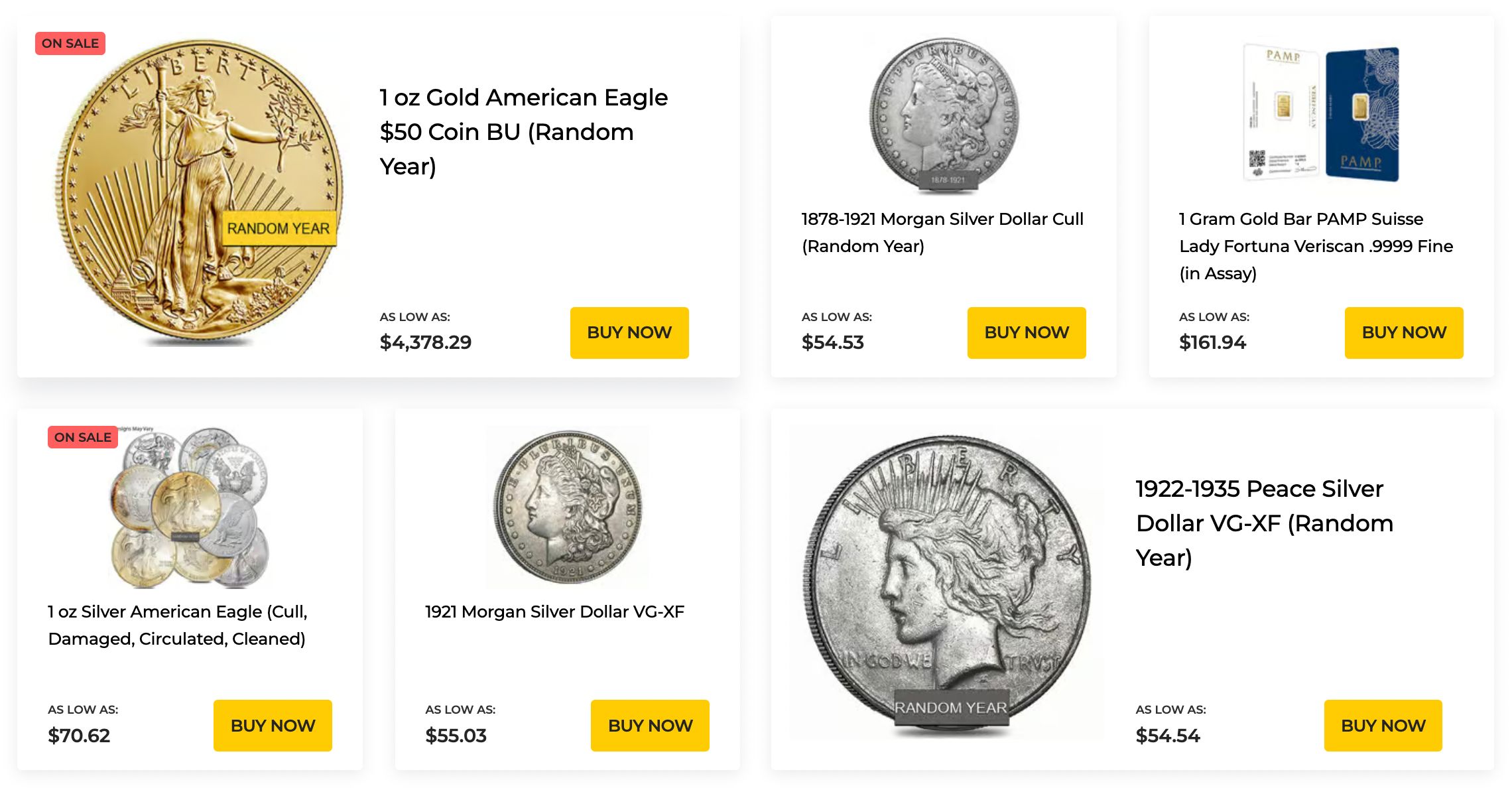
The catalog here runs deeper than most online dealers, and that breadth is both a draw and a trap. You get the standard four metals plus some unusual extras, and a collectible lean that can quietly inflate your cost.
Metals, Mints, and the Collectible Lean
The core inventory covers gold, silver, platinum, and palladium in bars, coins, and rounds. They also stock copper, rhodium, and ruthenium, which you rarely see elsewhere.
Sourcing comes from recognized sovereign mints and refiners:
- Mints: US Mint, Royal Mint, Royal Canadian Mint, Perth Mint, Austrian Mint, and more
- Refiners: PAMP Suisse, Valcambi, Argor-Heraeus, Asahi, and Credit Suisse
- House series: “Bullion Exchanges Exclusives” like Weapons of War and American Breakfast collections
- Extras: Goldbacks, junk silver, ancient coins, and storage supplies
That collectible-heavy catalog is fun to browse, but it pulls some buyers toward numismatic products that carry far higher markups than plain bullion. If you came for ounces, stay focused on ounces.
How Their Premiums Sit Against Spot
On standard bullion, their pricing sits close to live spot, and they back it with a price-match policy against named rivals like APMEX and JM Bullion. For common coins and bars, you are competitive.
The collectible tilt is where cost creeps up. Exclusive series and graded numismatics carry premiums that have little to do with the metal weight. You can track fair spot pricing yourself through a source like Kitco and compare before you commit.
The Buying Process, Step by Step
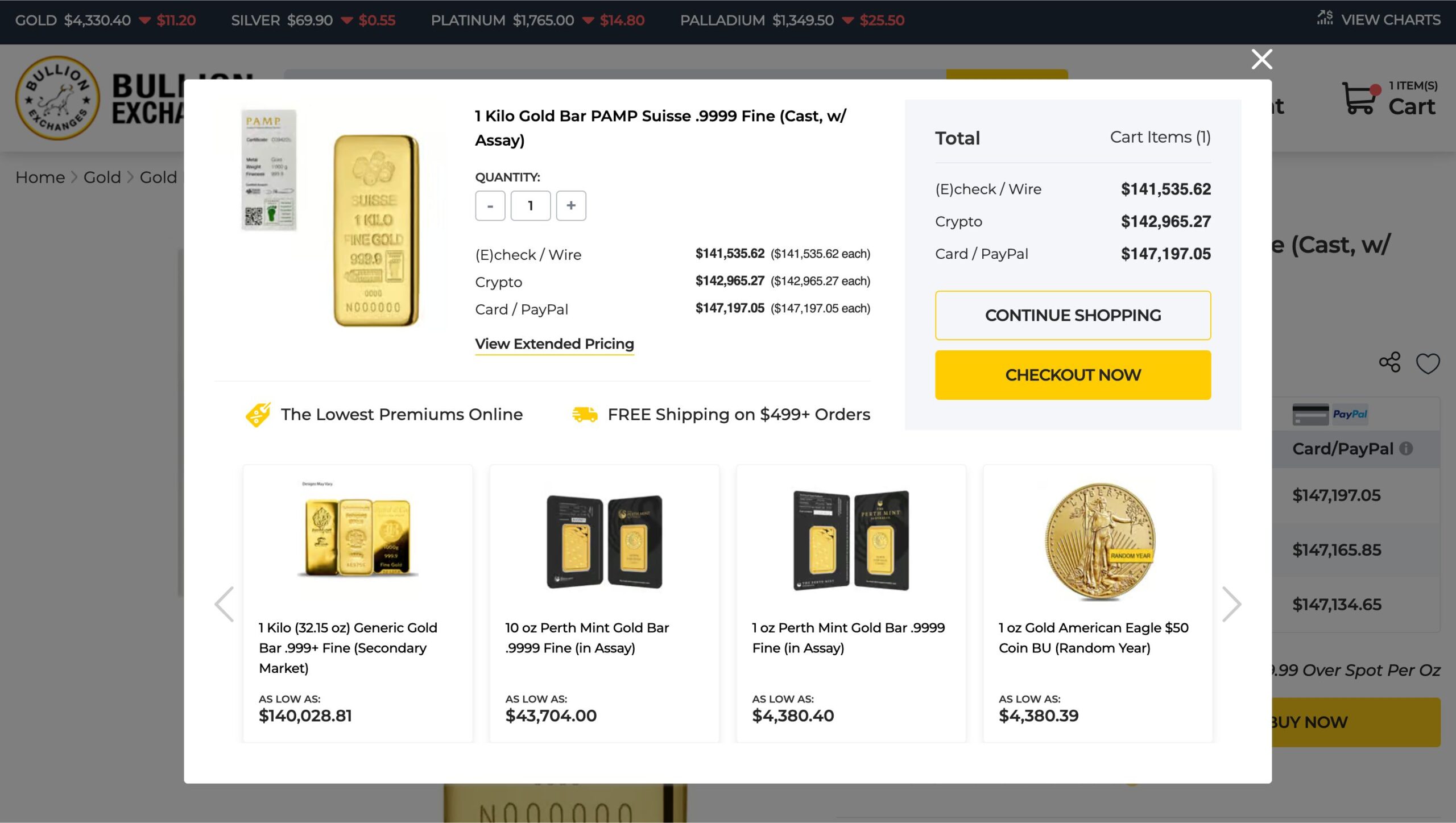
The mechanics here are straightforward until one verification step surprises first-timers. Knowing the flow in advance is the single best way to avoid the panic that fuels most negative reviews.
Placing an Order and Locking Your Price
When you add items to the cart, your price holds for about 10 minutes before it re-prices to current spot. Once you place the order, there are no price adjustments in either direction, even if metal moves against you.
Phone orders require a $500 minimum, website orders have no minimum, and in-store buys start at $1,000. Payment options online include checks, ACH via Plaid, wire, Bitcoin, PayPal, and major cards. Each method carries different processing fees, so the total varies by how you pay.
The Order-Screening Hold That Trips People Up
This is the part that trips up more buyers than anything else. After you order, an anti-money-laundering and risk-screening system reviews the transaction.
Some orders get flagged as “high risk” or pending verification, and a 10% hold can land on a credit card to lock pricing until payment clears.
To a first-timer, a pending authorization can look exactly like vanished money. It usually is not. These screens are standard fraud protection that any compliant dealer runs under federal anti-money-laundering rules, which you can read about through FinCEN.
Still, the communication around these holds is weak, and that is a fair criticism. If your order stalls, call before you assume the worst.
Shipping, Packaging, and the “Eight-Day” Frustration
Shipping is free on orders of $499 or more, otherwise a $7.99 charge applies. Most orders ship within one to five business days after cleared payment, mostly via USPS with discreet labeling, full tracking, and insurance until delivery. Packages over $1,000 require a signature.
The packaging itself draws praise for being almost over-engineered. The frustration is timing. Between payment clearing holds and the screening step, some buyers report waiting around eight days before a box moves, which feels long when you have already paid.
Where Bullion Exchanges Frustrates Buyers
Honesty means listing the friction plainly. These are the recurring pain points that show up across review platforms, and none of them are deal-breakers on their own:
- Payment holds that look like lost money during verification
- Shipping delays stacking clearing time onto processing time
- Occasional damaged or “not-as-described” coins requiring returns
- Uneven phone support, great for some, slow and curt for others
None of this points to fraud. It points to an online operation that handles a high volume and lets fulfillment friction reach the customer.
For a cautious buyer, the fix is simple: pay by a method that clears faster, document everything, and inspect coins on arrival within the claim window.
The Side-Door Gold IRA Option
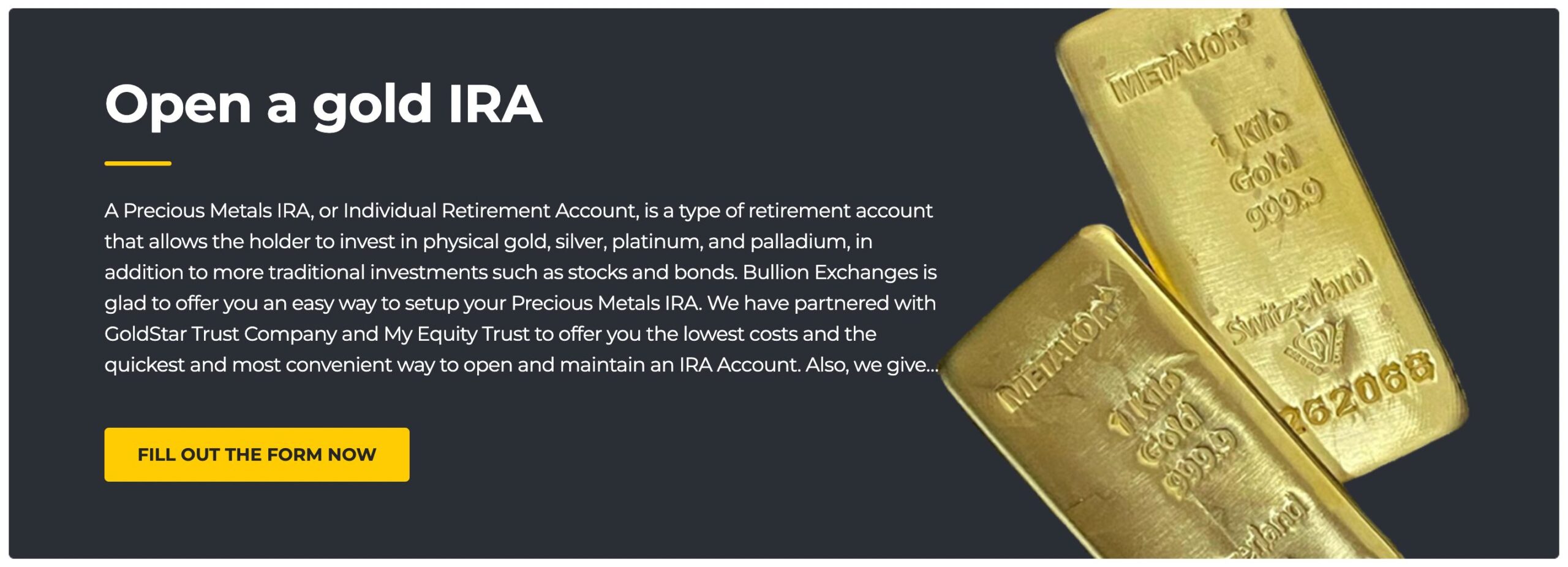
If you came here for retirement metal, know that this is not their main act. Bullion Exchanges facilitates a self-directed precious metals IRA, but they route the heavy lifting through outside partners.
The structure works like this:
- Custodians such as New Direction or GoldStar Trust handle the account
- Depositories like IDS Delaware, IDS Canada, or SWP Cayman store the metal
- Bullion Exchanges supplies the IRS-approved coins and bars
The five-step setup is fine, but the IRA pages load only through JavaScript, so custodian names and fees are hard to confirm from the static site.
For retirement money, a firm built around IRAs may serve you better, since their entire process is wrapped around custodian coordination and rollover support. Before funding any gold IRA, confirm the rules with the IRS retirement plan guidance.
What the Rating Sites Really Say About Bullion Exchanges
This is the section that actually answers your question. Instead of cherry-picking one score, here is every major signal reconciled side by side.
Better Business Bureau
The company holds an A+ rating and has been BBB accredited since December 2015. Customer reviews average about 3.78 out of 5 from 41 reviews.
Complaint volume over a rolling three-year window ran around 17 cases, mostly payment holds, delivery delays, and cancellations. The company responds actively, usually citing compliance screening.
Trustpilot
This is where the picture darkens. Trustpilot shows roughly 3.2 out of 5 from more than 1,058 reviews. Positive themes praise pricing, discreet packaging, and repeat-customer loyalty. Negative themes hammer on delayed shipping, damaged items, and inconsistent service.
Google and Yelp
The in-person reputation tells a sunnier story. Google reviews land near 4.5 out of 5 from around 907 reviews, and Yelp shows about 3.8 out of 5 from 112 reviews, with feedback skewing positive for people who buy at the counter.
That gap between Google and Trustpilot is not random. It is the walk-in channel outperforming the ship-to-home channel, exactly as I flagged earlier.
Shopper Approved
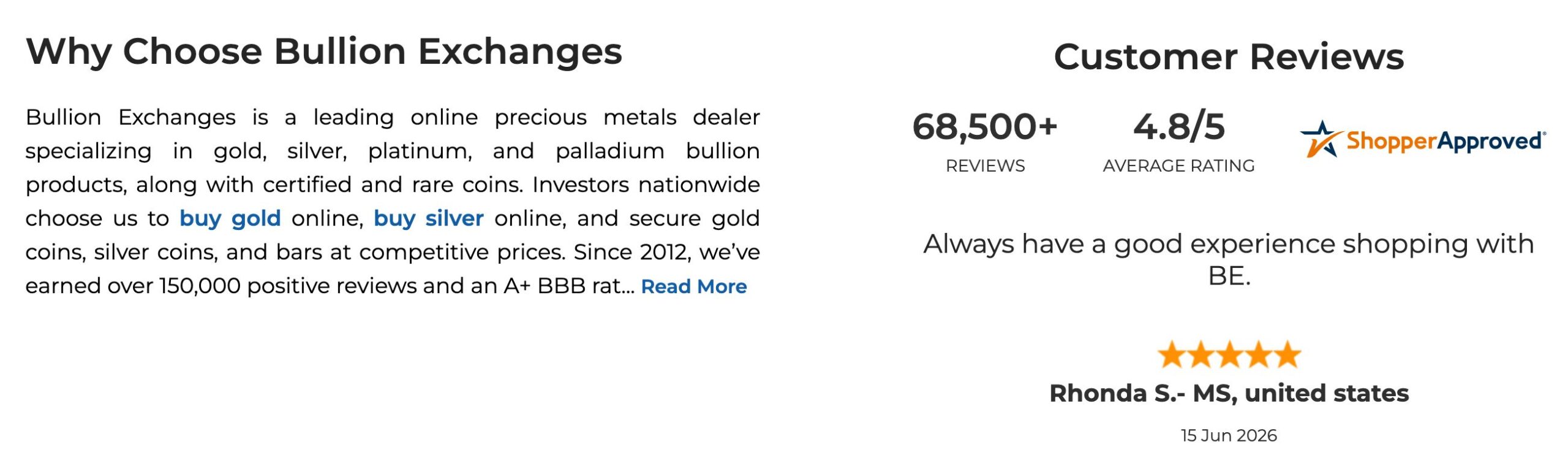
The footer of their own site links to Shopper Approved, where the rating sits at roughly 4.8 out of 5 from over 68,000 reviews.
That volume dwarfs every other platform. Some of that comes from post-purchase survey solicitation, so weigh it as one input, not gospel.
Reading the Scores Honestly
Put it all together and the spread makes sense:
- High scores cluster around in-store visits and post-purchase surveys
- Low scores cluster around online fulfillment, holds, and shipping timing
- No score, high or low, points to buyers never receiving their metal
So the honest read is this: the product and pricing are solid, the online process is where people get irritated. That is a friction problem, not a trust problem.
Who Bullion Exchanges Fits and Who Should Skip It
Two short lanes, no hedging.
A good fit if you are:
- A selection-hungry buyer who wants unusual coins and metals
- Price-conscious and willing to compare premiums yourself
- Comfortable with identity verification and a short hold
A poor fit if you are:
- A first-timer wanting hand-holding through every step
- A perfectionist who will return any coin with a minor flaw
- Looking for a turnkey gold IRA with one phone call
In plain terms: experienced stackers chasing variety and fair bullion pricing will do well here. Nervous beginners and IRA-focused retirement savers will likely feel more at ease with a dealer built around guidance.
Frequently Asked Questions
Q1. Why Is My Bullion Exchanges Payment Showing as Pending or Held?
A pending charge usually means their fraud and anti-money-laundering screening is reviewing your order, and a 10% authorization may sit on a card to lock pricing.
It is standard compliance, not a lost payment. Call customer service if it does not clear within a few business days.
Q2. How Long Does Bullion Exchanges Actually Take to Ship?
Most orders ship within one to five business days after payment clears. With check or ACH clearing holds added on, total delivery can stretch toward a week or more. Wire transfers tend to move fastest.
Q3. Can I Visit Bullion Exchanges in Person Instead of Ordering Online?
Yes. Their retail store at 30 West 47th Street is open weekdays, and in-person buyers consistently report the best experience. In-store purchases require a $1,000 minimum and accept cash, check, ACH, or wire, but not cards.
Q4. Does Bullion Exchanges Buy Back Metals, and at What Price?
They run a buyback service for gold, silver, platinum, jewelry, and more, with a free appraisal. Offers of $7,500 or more qualify for guaranteed pricing and avoid processing fees, while smaller sales carry a $25 to $50 fee. You ship at your own risk, since they do not provide prepaid labels.
Q5. Is Bullion Exchanges Safe for a Large First-Time Purchase?
For a large order, a wire transfer plus a signature-required delivery is the safest path, and the company is legitimate enough to handle it.
Expect verification steps on big purchases. If a hands-off, fully guided experience matters more to you, consider a more concierge-style dealer instead.
My Honest Verdict on Bullion Exchanges
So back to the contradiction I opened with. Bullion Exchanges is a legitimate, long-running dealer with a real storefront, named owners, deep selection, and competitive bullion pricing. The mixed online scores trace to fulfillment friction, not fraud. Buyers get their metal.
The company fits price-conscious stackers comfortable with verification steps. First-timers wanting hand-holding or a turnkey IRA should look elsewhere. Buy with a wire, inspect on arrival, and you will likely do fine here.
Goldco Precious Metals
- Goldco Surpasses $2 Billion in Precious Metals Placements
- Over 6,000 Five-Star Ratings on BBB, Trustpilot, and ConsumerAffairs
- Seven-Time Winer on the Inc. 5000 List